


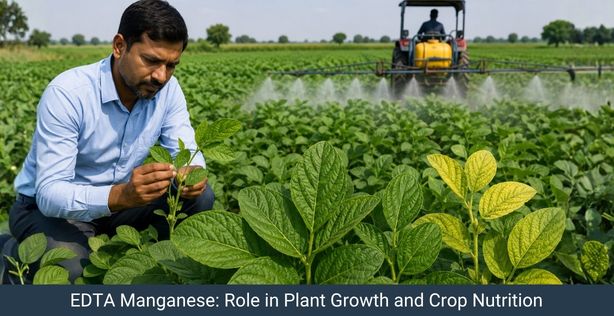
Introduction to EDTA Manganese in Modern Crop Nutrition
Balanced plant nutrition is fundamental to achieving high crop productivity, superior produce quality, and sustainable agricultural practices. While primary nutrients such as nitrogen, phosphorus, and potassium receive significant attention, micronutrients are equally important for supporting essential physiological and biochemical processes within plants. Among these micronutrients, manganese plays a vital role in plant metabolism, photosynthesis, enzyme activation, and stress tolerance.
EDTA Manganese, scientifically known as Ethylenediaminetetraacetic Acid Manganese Chelate, is one of the most effective sources of plant available manganese. It is extensively used in water soluble fertilizers, specialty fertilizers, foliar sprays, fertigation systems, hydroponics, greenhouse cultivation, and precision agriculture due to its superior stability and nutrient availability.
The product is also recognized internationally as Manganese EDTA, Mn EDTA, Chelated Manganese, Manganese Chelate, and EDTA Mn. Regardless of the commercial name used across different countries, the objective remains the same, which is to provide highly available manganese for optimum crop growth under diverse soil conditions.
As agriculture increasingly focuses on improving nutrient use efficiency and maximizing crop performance, EDTA Manganese has become an essential component of modern micronutrient management programs.
Understanding the Role of Manganese in Plants
Manganese is classified as an essential micronutrient because plants require it to complete their life cycle. Although needed in relatively small quantities, its absence can significantly affect growth, development, and yield.
Manganese contributes to numerous physiological activities including
- Photosynthesis
- Enzyme activation
- Chlorophyll formation
- Nitrogen metabolism
- Carbohydrate synthesis
- Protein formation
- Energy transfer
- Root development
- Reproductive growth
- Natural plant defense mechanisms
Healthy crops depend upon adequate manganese availability throughout various stages of development.
Why Chelated Manganese Performs Better
Traditional manganese fertilizers often lose effectiveness after application because manganese ions react with soil minerals and become unavailable to plant roots.
EDTA Manganese overcomes this limitation through chelation.
The EDTA molecule surrounds manganese ions and protects them from undesirable chemical reactions within the soil solution. This allows manganese to remain soluble and available for plant uptake over a longer period.
The result is
- Higher nutrient availability
- Improved absorption
- Better nutrient efficiency
- Reduced fixation
- Enhanced crop response
- Uniform nutrient distribution
- Greater formulation stability
- Reliable performance under challenging soil conditions
These advantages make EDTA Manganese an excellent choice for advanced crop nutrition programs.
Importance in Photosynthesis
Photosynthesis is the process through which plants convert sunlight into usable energy.
Manganese actively participates in this process by supporting the water splitting reaction that produces oxygen during photosynthesis.
Adequate manganese nutrition helps maintain
| Plant Function | Contribution of Manganese |
| Chlorophyll activity | Improved photosynthesis |
| Energy production | Higher growth efficiency |
| Carbon assimilation | Better biomass development |
| Leaf productivity | Enhanced green foliage |
| Plant metabolism | Healthy physiological activity |
Efficient photosynthesis directly supports higher crop productivity.
Contribution to Enzyme Activation
Plants contain numerous enzymes responsible for regulating growth, metabolism, and nutrient utilization.
Manganese activates several important enzyme systems involved in
- Carbohydrate metabolism
- Nitrogen utilization
- Lipid metabolism
- Protein synthesis
- Cellular respiration
- Hormonal regulation
- Antioxidant activity
- Organic acid production
Without sufficient manganese, many biochemical reactions slow down, affecting overall crop performance.
Support for Chlorophyll Development
Healthy green leaves indicate efficient chlorophyll production.
Although manganese is not a structural component of chlorophyll, it plays a significant supporting role in chlorophyll synthesis and maintenance.
Adequate manganese nutrition promotes
- Uniform green coloration
- Improved leaf development
- Higher photosynthetic efficiency
- Better canopy formation
- Increased biomass accumulation
These improvements contribute to stronger vegetative growth throughout the cropping cycle.

Strengthening Plant Defense Systems
Plants continuously face environmental challenges including drought, heat, nutrient imbalance, and disease pressure.
Manganese contributes to natural defense mechanisms by supporting enzymes involved in antioxidant protection and cell wall development.
Proper manganese nutrition assists plants in maintaining
- Stronger plant tissues
- Improved stress tolerance
- Better recovery from environmental stress
- Enhanced resistance to physiological disorders
- Improved crop vigor
- Healthier overall growth
Balanced micronutrient nutrition therefore supports sustainable crop production.
Role in Root Development
Healthy roots determine the efficiency with which plants absorb water and nutrients.
EDTA Manganese supports vigorous root growth by maintaining continuous manganese availability throughout the active root zone.
Well developed root systems provide
- Improved nutrient uptake
- Better water absorption
- Stronger plant establishment
- Enhanced anchorage
- Greater tolerance to moisture variation
- Higher nutrient use efficiency
Robust root development forms the foundation of productive crop growth.
Our Other Product
Manganese Bisglycinate (Manganese Glycinate)Crops That Benefit from EDTA Manganese
A wide variety of commercial crops respond positively to balanced manganese nutrition.
Major agricultural crops include
- Wheat
- Rice
- Maize
- Cotton
- Soybean
- Groundnut
- Sugarcane
- Potato
- Tomato
- Onion
- Chilli
- Citrus
- Grapes
- Banana
- Apple
- Mango
- Tea
- Coffee
- Floriculture crops
- Plantation crops
High value horticultural crops often require carefully managed micronutrient programs to achieve premium market quality.
Suitable Application Methods
EDTA Manganese offers flexibility across multiple agricultural practices.
| Application Method | Agricultural Advantage |
| Foliar spray | Rapid nutrient correction |
| Fertigation | Uniform nutrient delivery |
| Drip irrigation | Efficient root zone application |
| Hydroponics | Precise nutrient management |
| Water soluble fertilizer blends | Excellent compatibility |
| Greenhouse cultivation | Controlled nutrition |
This versatility makes EDTA Manganese suitable for both conventional and advanced farming systems.
Performance Under Different Soil Conditions
Soil chemistry strongly influences manganese availability.
In acidic soils, manganese is generally more available to plants.
However, in neutral, alkaline, and calcareous soils, manganese can become chemically unavailable due to reactions with soil minerals.
EDTA Manganese remains effective across a wider range of soil conditions because the chelated structure protects manganese from rapid precipitation and fixation.
This characteristic improves nutrient efficiency where conventional manganese fertilizers often perform less effectively.
Integration with Precision Agriculture
Modern farming increasingly emphasizes efficient nutrient management through scientific application techniques.
EDTA Manganese supports precision agriculture by providing
- Accurate nutrient delivery
- Uniform crop response
- Better nutrient utilization
- Reduced fertilizer wastage
- Improved fertigation compatibility
- Efficient micronutrient management
- Consistent crop quality
- Sustainable production practices
These benefits align with the evolving requirements of commercial agriculture.
Agricultural Sectors Driving Global Demand
Growing adoption of advanced farming technologies has expanded worldwide demand for EDTA Manganese.
Major consuming sectors include
- Water soluble fertilizer manufacturers
- Specialty fertilizer producers
- Micronutrient formulation companies
- Hydroponic nutrient manufacturers
- Greenhouse cultivation suppliers
- Commercial horticulture
- Plantation agriculture
- Precision farming operations
- Export oriented agriculture
- Agricultural input distributors
Increasing awareness of balanced crop nutrition continues to support market growth.
Factors Buyers Should Evaluate Before Procurement
Bulk buyers should assess both product quality and supplier capability before procurement.
Important considerations include
| Procurement Parameter | Business Importance |
| Manganese content | Nutrient performance |
| Chelation percentage | Product stability |
| Water solubility | Application efficiency |
| Product purity | Formulation consistency |
| Batch uniformity | Manufacturing reliability |
| Packaging quality | Safe transportation |
| Technical documentation | Regulatory compliance |
| Production capacity | Supply continuity |
| Export experience | Global logistics |
| Technical support | Customer confidence |
A structured procurement process helps ensure consistent product performance.
Why India Has Become a Leading Source of EDTA Manganese
India has emerged as an important global manufacturing hub for chelated micronutrients due to its strong chemical industry, experienced workforce, modern production facilities, and competitive manufacturing costs.
International buyers increasingly source EDTA Manganese from India because manufacturers provide:
- Consistent manufacturing quality
- Competitive pricing
- Large production capacity
- Advanced laboratory testing
- Reliable export logistics
- Flexible packaging solutions
- Comprehensive technical documentation
- Customer focused technical support
- Stable long term supply
Selecting a Reliable Manufacturing Partner
Long term procurement success depends upon choosing manufacturers capable of delivering consistent quality and dependable service.
Professional buyers generally evaluate
- Manufacturing expertise
- Product quality systems
- Laboratory infrastructure
- Production capacity
- Export capability
- Documentation standards
- Packaging flexibility
- Delivery performance
- Technical support
- Long term business reliability
Strong supplier relationships help fertilizer manufacturers and agricultural distributors maintain uninterrupted operations while ensuring customer satisfaction.
Our Other Product
Copper Bisglycinate (Copper Glycinate)Conclusion
EDTA Manganese plays an indispensable role in modern crop nutrition by improving manganese availability, supporting photosynthesis, activating essential enzymes, enhancing chlorophyll development, strengthening root systems, and promoting healthy plant growth. Its chelated structure allows efficient nutrient delivery across diverse soil conditions, making it particularly valuable for precision agriculture, greenhouse cultivation, fertigation, hydroponics, and high value crop production.
As global agriculture continues to prioritize nutrient efficiency, sustainable farming, and improved crop productivity, demand for premium quality EDTA Manganese will continue to expand. For fertilizer manufacturers, agrochemical companies, importers, distributors, and international procurement organizations seeking reliable chelated micronutrients, Shivam Agro Industries offers high quality EDTA Manganese manufactured to meet the evolving technical and commercial requirements of global agricultural markets.