


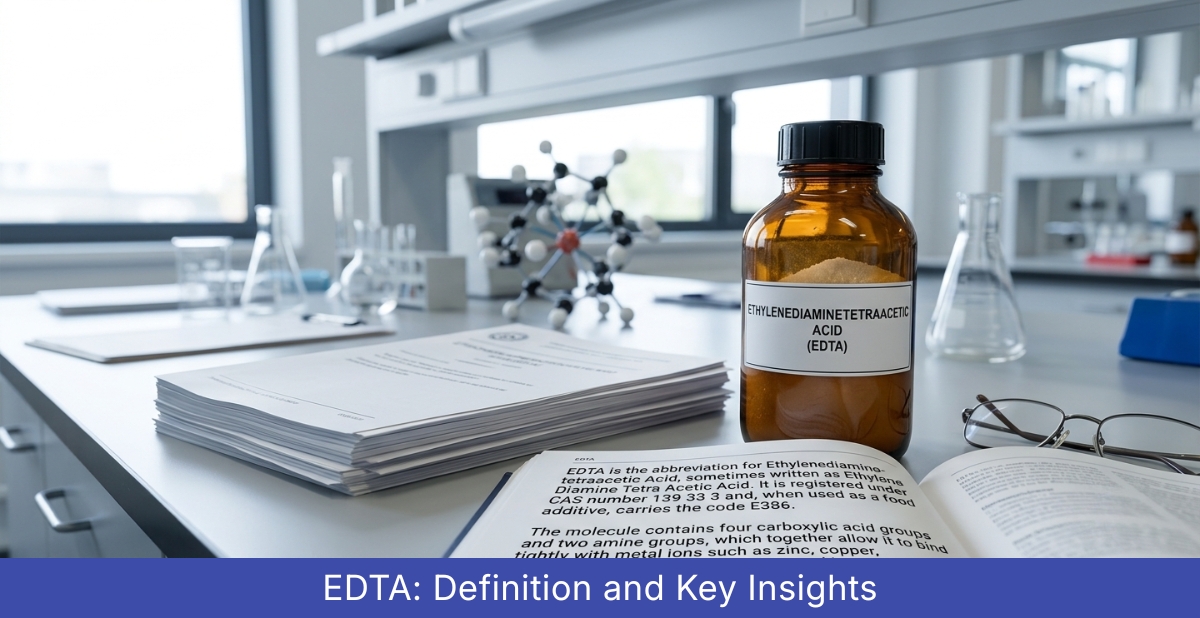
What EDTA Actually Stands For
EDTA is the abbreviation for Ethylenediaminetetraacetic Acid, sometimes written as Ethylene Diamine Tetra Acetic Acid. It is registered under CAS number 139 33 3 and, when used as a food additive, carries the code E386. The molecule contains four carboxylic acid groups and two amine groups, which together allow it to bind tightly with metal ions such as zinc, copper, manganese, magnesium, calcium and iron. This binding action, known as chelation, is the reason EDTA and its metal salts are described as chelating agents or sequestering agents across scientific literature and product labeling worldwide.
Alternate Names and Regional Terminology for EDTA
EDTA and its sodium salts are known by several trade and pharmacopoeial names depending on the country and industry. Disodium EDTA is also referred to as Edetate Disodium in pharmaceutical contexts, Disodium Edetate in cosmetic ingredient listings, and Disodium Ethylenediaminetetraacetate in formal chemical nomenclature. Older industrial literature sometimes uses the historic trade name Sequestrene NA2 for the disodium salt. In shorthand chemical notation the disodium form is written as Na2EDTA or EDTA 2Na, while related derivatives include Disodium Dihydrogen EDTA and Disodium Edetate Dihydrate. Buyers researching this chemical in different markets may also encounter the general descriptive terms EDTA pure acid, EDTA powder and Ethylenediaminetetraacetic Acid Disodium Salt, all referring to closely related forms of the same base chemistry.
EDTA Acid and EDTA Disodium: The Foundation Salts
EDTA acid, also called EDTA pure acid or Ethylenediaminetetraacetic Acid, is the parent compound from which every other chelate in this category is manufactured. Shivam Agro Industries supplies pharmaceutical grade EDTA acid along with EDTA disodium, the partially neutralized sodium salt used extensively as a sequestrant in detergents, textile processing and water treatment. EDTA disodium is offered in dihydrate and anhydrous forms and is recognized under names including Disodium EDTA, Edetate Disodium and Disodium Edetate depending on the industry using it.
EDTA Tetrasodium: The Fully Neutralized Sequestrant
EDTA tetrasodium is the fully sodium neutralized form of Ethylenediaminetetraacetic Acid, offering higher solubility across a wider pH range compared to EDTA disodium. It is widely used in industrial cleaning formulations, oilfield chemicals and specialty agricultural blends where rapid solubility and strong metal binding capacity across alkaline conditions are required. Shivam Agro Industries manufactures and exports EDTA tetrasodium to formulators seeking a dependable EDTA tetrasodium supplier for bulk and wholesale requirements.
EDTA Chelated Micronutrients: The Metal Salt Range
The largest share of global demand for EDTA chemistry comes from chelated micronutrient fertilizers used to correct soil and plant nutrient deficiencies. Each metal EDTA chelate offered by ShivamAgro Industries is manufactured to a defined percentage of elemental metal, ensuring consistent agronomic performance for foliar spray and fertigation programs.
| Chelate | Full Chemical Description | Primary Agricultural Role |
|---|---|---|
| EDTA Zinc | Zinc Ethylenediaminetetraacetate, also called Zinc Disodium EDTA or zinc EDTA | Corrects zinc deficiency, supports enzyme activation and chlorophyll formation |
| EDTA Copper | Copper Ethylenediaminetetraacetate | Supports enzyme function and lignin synthesis in plant tissue |
| EDTA Manganese | Manganese Ethylenediaminetetraacetate | Aids photosynthesis and activates key metabolic enzymes |
| EDTA Magnesium | Magnesium Ethylenediaminetetraacetate | Central component of chlorophyll, supports energy transfer in plants |
| EDTA Calcium | Calcium Ethylenediaminetetraacetate | Strengthens cell walls, reduces disorders such as blossom end rot |
| EDTA Ferric | Ferric Ethylenediaminetetraacetate, also written Fe EDTA | Corrects iron chlorosis in neutral to mildly alkaline soils up to pH 7.5 |
Our Other Product
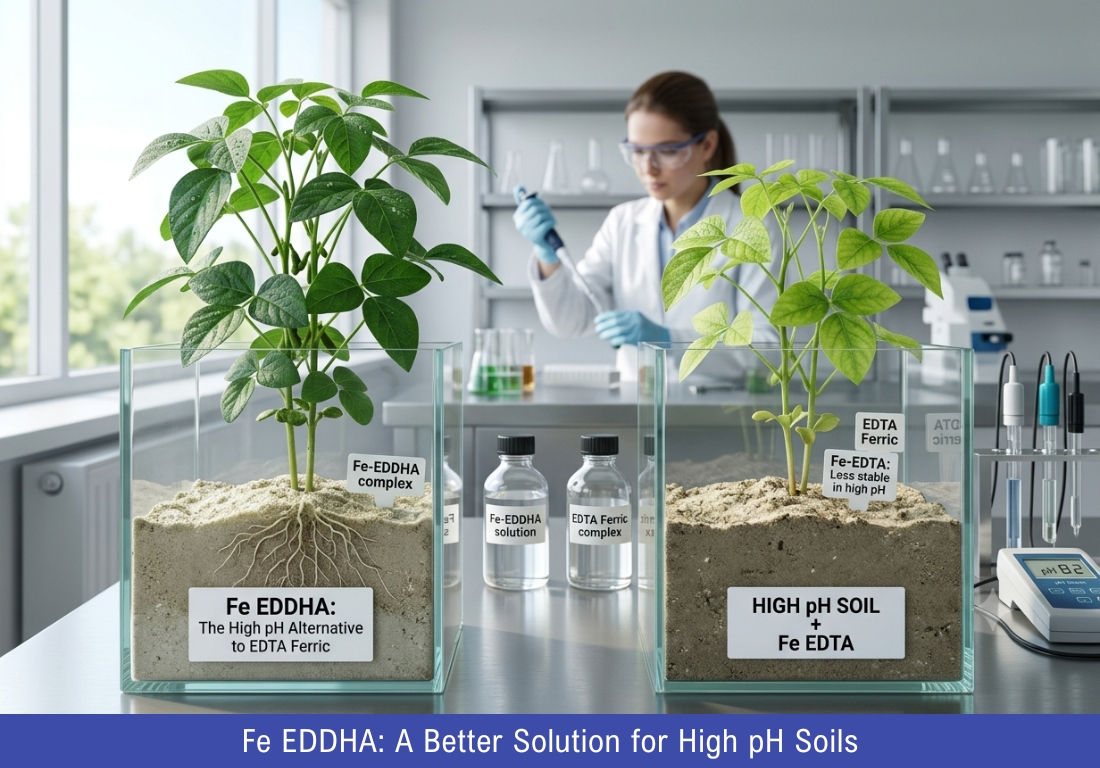
Zinc Sulfate Monohydrate 33% & 36%Fe EDDHA: The High pH Alternative to EDTA Ferric
Fe EDDHA is a distinct iron chelate built on an EDDHA ligand rather than EDTA, giving it stability in soils with pH values as high as 11, well beyond the effective range of EDTA ferric. ShivamAgro Industries manufactures Fe EDDHA alongside EDTA ferric so that formulators and distributors can choose the correct iron source depending on the soil chemistry of the target market, offering a single sourcing point for both moderate and high pH iron correction needs.
Bis Glycinate Chelates: The Next Generation Range
Alongside EDTA chemistry, ShivamAgro Industries produces a complete line of glycine based chelates, often described as Bis Glycinate or simply glycinate salts. These are formed by chelating a metal ion with two molecules of glycine, the simplest amino acid, resulting in a compact, highly bioavailable mineral form used in both plant nutrition and animal feed applications. Depending on the market, these products are referred to interchangeably as metal glycinate, metal glycine chelate or metal Bis Glycinate.
| Amino Acid Chelate | Also Known As | Typical Application |
|---|---|---|
| Zinc Bis Glycinate | Zinc Glycinate, Zinc Glycine Chelate | Animal feed premix and foliar nutrition |
| Ferrous Bis Glycinate | Iron Glycinate, Ferrous Glycine Chelate | Feed grade iron source with high bioavailability |
| Copper Bis Glycinate | Copper Glycinate, Copper Glycine Chelate | Feed premix and micronutrient blends |
| Calcium Bis Glycinate | Calcium Glycinate, Calcium Glycine Chelate | Foliar calcium correction and feed supplementation |
| Manganese Bis Glycinate | Manganese Glycinate, Manganese Proteinate | Enzyme cofactor supply in feed and fertigation |
| Magnesium Bis Glycinate | Magnesium Glycinate, Magnesium Glycine Chelate | Chlorophyll support and feed mineral supplementation |
| Cobalt Bis Glycinate | Cobalt Glycinate | Ruminant feed cobalt source |
| Chromium Bis Glycinate | Chromium Glycinate | Trace mineral premix for livestock nutrition |
| Potassium Bis Glycinate | Potassium Glycinate | Potassium supplementation in specialty nutrition |
| Selenium Bis Glycinate | Selenium Glycinate | Organic selenium source for feed formulation |
Glycine: The Building Block Behind Every Bis Glycinate Chelate
Glycine, the smallest and simplest amino acid, is the raw material used to manufacture every Bis Glycinate product in the ShivamAgro Industries range. As a standalone product, glycine is also supplied to feed, food and pharmaceutical manufacturers, making it one of the most versatile intermediates connecting the amino acid chelate business to broader nutrition and life science industries.
Conventional Micronutrient Salts Alongside the Chelate Range
In addition to EDTA and amino acid chelates, Shivam Agro Industries supplies Dried Ferrous Sulphate, Copper Sulphate and Dried Magnesium Sulphate, giving fertilizer blenders access to both conventional inorganic micronutrient salts and modern chelated forms from a single manufacturing source, simplifying formulation choices for buyers who require both product categories in their nutrient blends.
How Different Countries and Industries Name the Same Chemistry
A recurring challenge for international buyers is that identical chemistry is marketed under different names depending on the destination market and end use industry. Pharmacopoeial listings in the United States and Europe typically use Edetate Disodium, while agricultural distributors across Asia and the Middle East more commonly search for EDTA Disodium or EDTA Salt. Cosmetic ingredient databases list the same chemical as Disodium EDTA or Disodium Edetate. In francophone and other non English speaking markets, buyers often search using the full scientific term AcideEthylenediaminetetraacetiquealongside the widely recognized EDTA abbreviation, while food industry documentation across the European Union references the additive code E386 rather than the chemical name. Recognizing these naming variations helps global buyers confirm they are sourcing the correct chelate regardless of the terminology used in their local regulatory framework.
Our Other Product
GlycineChoosing the Right EDTA Salt or Chelate for Your Requirement
Selecting between EDTA acid, EDTA disodium, EDTA tetrasodium, a specific metal EDTA chelate, Fe EDDHA or a Bis Glycinate amino acid chelate depends on the intended use, target pH environment and required bioavailability. Formulators focused on foliar correction of a specific deficiency typically choose the matching metal EDTA chelate, those working in high pH soils select Fe EDDHA for iron correction, industrial cleaning and textile applications rely on EDTA disodium or EDTA tetrasodium for sequestration, and animal nutrition companies increasingly move toward Bis Glycinate chelates for superior mineral absorption. ShivamAgro Industries supports buyers across each of these use cases with a single, well documented product range manufactured in India.