


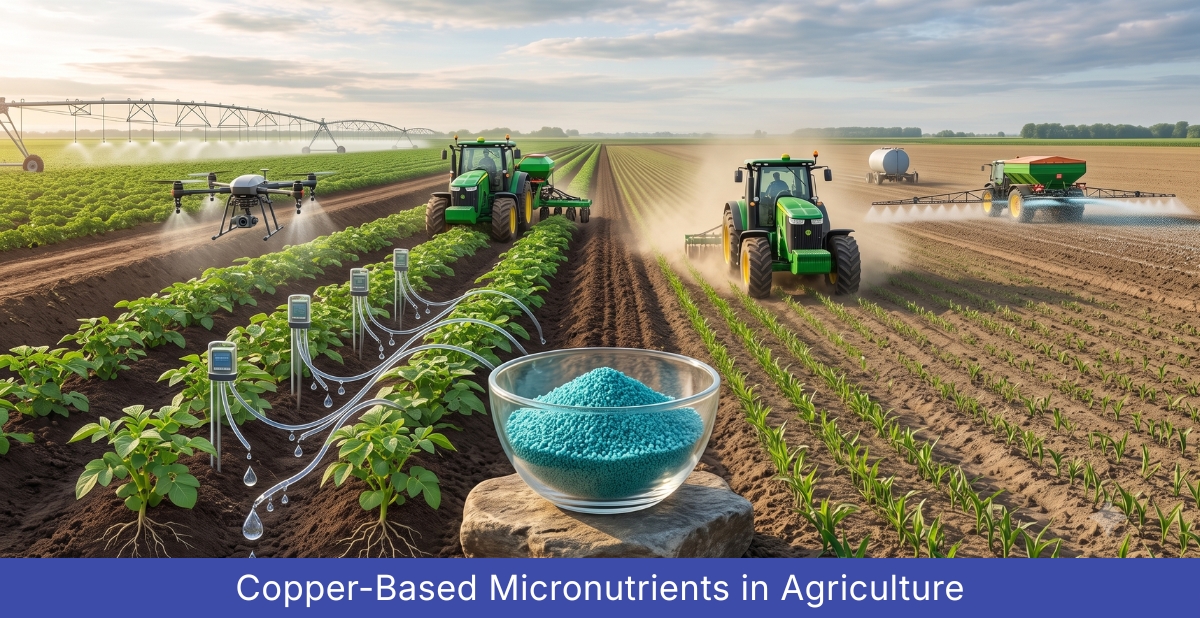
Introduction to Copper Based Micronutrient Fertilizers
Copper is one of the essential micronutrients required for healthy plant metabolism, reproductive development, enzyme activation, chlorophyll formation, lignin synthesis, and natural disease resistance. Although crops require copper in relatively small quantities, inadequate copper nutrition can significantly reduce yield, crop quality, flowering, seed formation, and overall plant vigor.
Among commercially available copper fertilizers, EDTA Copper and Copper Sulphate are the two most widely used products worldwide. Both supply copper to crops, yet they differ substantially in chemical stability, nutrient availability, application efficiency, compatibility with modern irrigation systems, and suitability for different soil conditions.
For fertilizer manufacturers, agrochemical companies, micronutrient formulators, distributors, exporters, government procurement agencies, and international importers, understanding these differences is essential for selecting the most appropriate product based on agronomic performance and commercial objectives.
Understanding EDTA Copper and Copper Sulphate
EDTA Copper is the abbreviated form of Ethylenediaminetetraacetic Acid Copper Chelate. It is a chelated micronutrient in which copper ions are chemically protected by EDTA, preventing undesirable reactions within soil and irrigation water. The product is also marketed globally as Copper EDTA, Chelated Copper, Cu EDTA, Copper Chelate Fertilizer, and Chelated Copper Micronutrient.
Copper Sulphate is an inorganic copper salt chemically known as Copper Sulphate Pentahydrate in its most common commercial form. Depending upon regional markets, it may also be referred to as Copper Sulfate, Bluestone, Blue Vitriol, Cupric Sulphate, Copper Sulfate Agricultural Grade, or Copper Sulphate Technical Grade.
Although both products deliver copper nutrition, their behavior after application varies significantly because of their different chemical structures.
Importance of Copper in Plant Nutrition
- Enzyme activation
- Photosynthesis
- Protein metabolism
- Respiration
- Chlorophyll formation
- Lignin development
- Cell wall strengthening
- Pollen fertility
- Seed production
- Natural defense against environmental stress
Chemical Characteristics Comparison
| Property | EDTA Copper | Copper Sulphate |
| Chemical Category | Chelated Copper | Inorganic Copper Salt |
| Full Form | Ethylenediaminetetraacetic Acid Copper | Copper Sulphate |
| Copper Availability | Very High | Moderate |
| Stability in Soil | Excellent | Moderate |
| Solubility | Highly Soluble | Highly Soluble |
| Performance in High pH Soil | Excellent | Limited |
| Nutrient Protection | Excellent | Low |
| Compatibility with Fertigation | Excellent | Moderate |
| Foliar Application | Excellent | Good |
| Precision Agriculture | Highly Suitable | Suitable |
Read Our Article
Why Global Buyers Prefer Indian EDTA ManufacturersCopper Availability Under Different Soil Conditions
One of the most important factors affecting fertilizer efficiency is soil chemistry.
In acidic soils, both EDTA Copper and Copper Sulphate generally perform satisfactorily because copper remains relatively available.
Neutral soils allow acceptable nutrient availability for both products, although EDTA Copper maintains more consistent nutrient stability.
Alkaline and calcareous soils present greater challenges because free copper ions released from Copper Sulphate can rapidly react with carbonates, phosphates, and hydroxides, reducing nutrient availability.
EDTA Copper protects copper ions through chelation, allowing the micronutrient to remain soluble and available for plant absorption even under challenging soil conditions.
Stability Makes the Difference
The principal advantage of EDTA Copper lies in its chemical stability.
Chelation forms a protective molecular structure around copper ions, preventing premature reactions with soil minerals and irrigation water components. This increases nutrient persistence within the root zone while reducing fixation losses.
Copper Sulphate dissolves rapidly after application, releasing free copper ions immediately. Although plants can absorb a portion of these ions, another portion may become chemically unavailable depending on soil composition and environmental conditions.
The greater stability of EDTA Copper contributes directly to improved micronutrient efficiency.
Our Other Product
Magnesium Sulphate AnhydrousCrop Suitability
- Fruits
- Citrus
- Grapes
- Vegetables
- Tomatoes
- Potatoes
- Onion
- Cotton
- Floriculture
- Greenhouse cultivation
- Hydroponics
- Precision farming
- High value horticulture
- Plantation crops
- Wheat
- Rice
- Pulses
- Oilseeds
- Field crops
- Large acreage cultivation
- Conventional farming systems
Compatibility with Modern Fertilizer Programs
- Water soluble fertilizers
- Liquid fertilizers
- NPK formulations
- Fertigation systems
- Drip irrigation
- Hydroponic nutrient solutions
- Foliar nutrition programs
- Precision agriculture technologies
Performance Through Foliar Nutrition
Foliar application has become an important method for correcting micronutrient deficiencies quickly.
EDTA Copper penetrates leaf tissues efficiently due to its stable chelated structure. It minimizes precipitation on leaf surfaces and allows improved nutrient absorption.
Copper Sulphate also performs effectively as a foliar nutrient when properly formulated and applied at recommended concentrations, although application precision becomes more important to avoid leaf injury under unfavourable conditions.
Read Our Article
Industries That Use EDTA Chemicals and Chelating AgentsCopper Deficiency Symptoms
Copper deficiency may appear differently depending on crop species and growth stage.
Common symptoms include
| Crop Response | Possible Indication |
| Young leaf distortion | Copper deficiency |
| Weak stem development | Poor lignin formation |
| Reduced flowering | Inadequate reproductive nutrition |
| Delayed maturity | Low copper availability |
| Poor grain filling | Reduced enzyme activity |
| Dieback of shoots | Severe deficiency |
| Lower fruit quality | Nutrient imbalance |
Early correction through efficient copper nutrition supports healthier crop development and improved productivity.
Environmental Considerations
Sustainable agriculture increasingly emphasizes nutrient use efficiency.
Chelated micronutrients help improve fertilizer utilization by reducing nutrient losses and maintaining longer nutrient availability within the plant root zone.
Efficient nutrient delivery contributes to balanced fertilization while supporting responsible resource management.
This is one reason why specialty fertilizer manufacturers increasingly incorporate chelated copper into advanced crop nutrition programs.
Global Demand Across Agricultural Markets
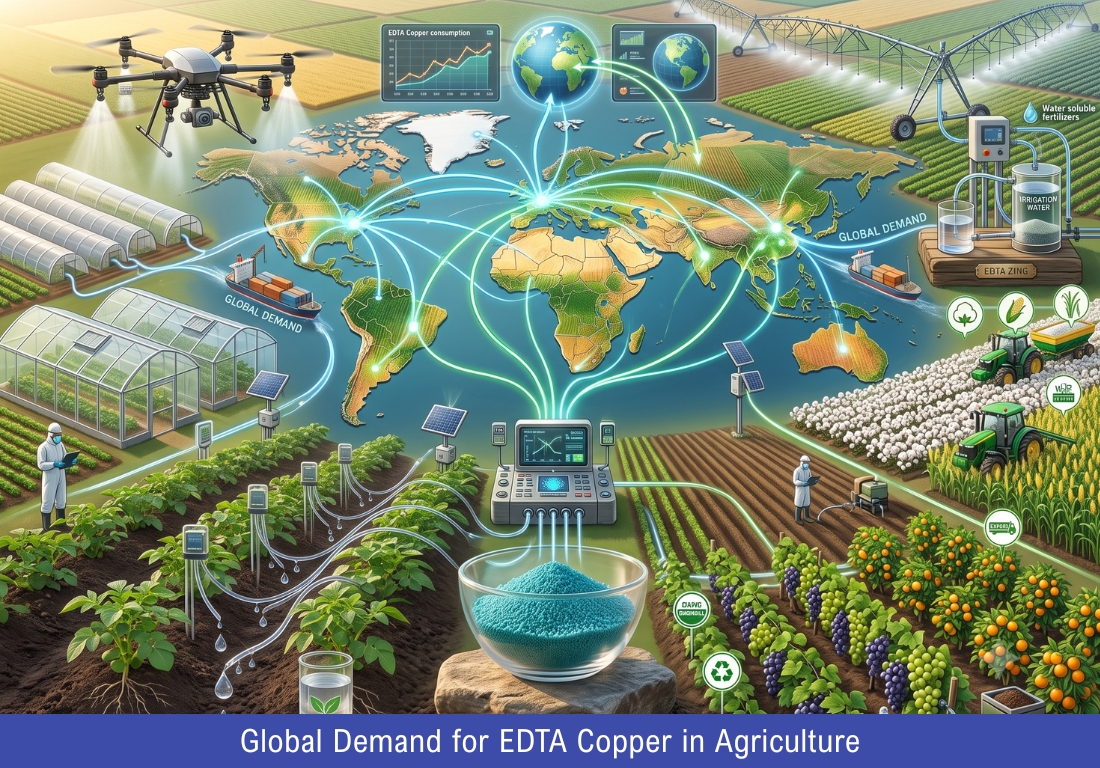
Demand for EDTA Copper continues to increase worldwide due to several agricultural trends.
Growing sectors include
- Specialty fertilizers
- Water soluble fertilizers
- Controlled environment agriculture
- Protected cultivation
- Precision farming
- Organic compatible nutrient management systems where permitted by regulations
- Commercial horticulture
- High value fruit production
- Greenhouse vegetable cultivation
- Export agriculture
Our Other Product
Manganese Bisglycinate (Manganese Glycinate)Copper Sulphate continues to maintain strong demand because of its versatility, affordability, and broad industrial applications.
Major Industries Purchasing EDTA Copper
- Micronutrient fertilizer manufacturers
- Specialty fertilizer producers
- Agrochemical companies
- Liquid fertilizer manufacturers
- Hydroponic nutrient manufacturers
- Agricultural distributors
- Export houses
- Contract manufacturing companies
- Agricultural research organizations
- Plantation management companies
- Government procurement agencies
- International fertilizer brands
Procurement Parameters for Global Buyers
| Procurement Parameter | Importance |
| Copper content | Product performance |
| Chelation percentage | Nutrient stability |
| Water solubility | Application efficiency |
| Product purity | Manufacturing consistency |
| Heavy metal compliance | Regulatory acceptance |
| Moisture content | Shelf stability |
| Batch uniformity | Production reliability |
| Export capability | Global supply continuity |
| Packaging flexibility | Logistics efficiency |
| Quality documentation | International compliance |
Why India Has Emerged as a Reliable Global Supplier
- Consistent production quality
- Large manufacturing capacity
- Competitive pricing
- Export compliant packaging
- Technical documentation
- Timely shipment schedules
- Flexible private labeling solutions
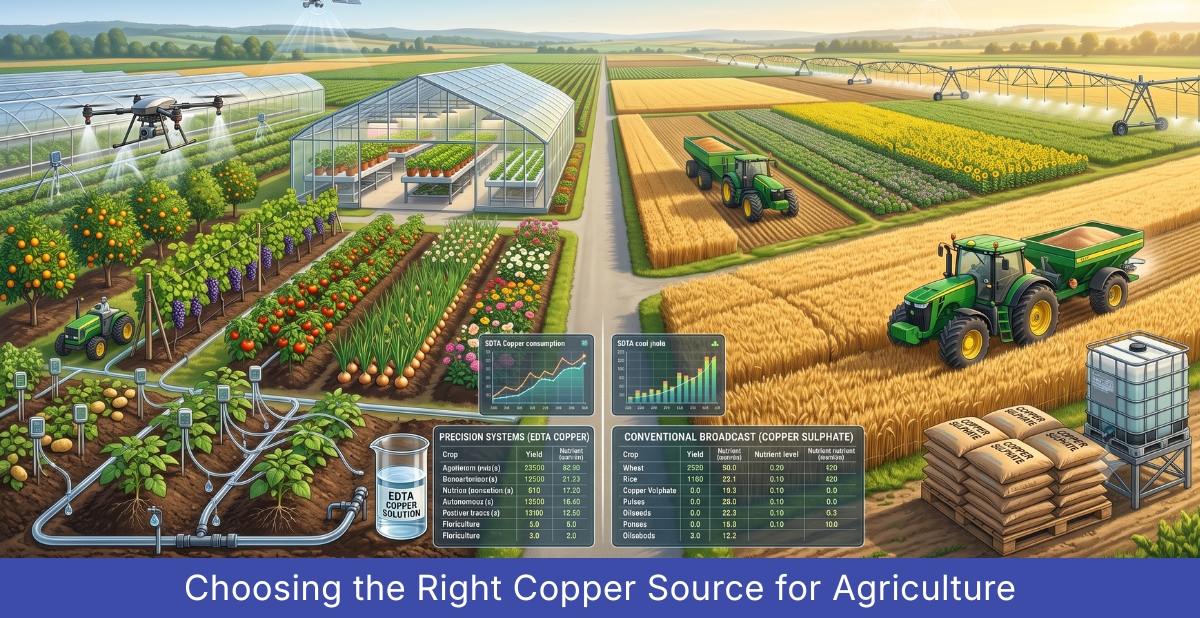
Choosing Between EDTA Copper and Copper Sulphate
Both products continue to play valuable roles within modern crop nutrition programs.
EDTA Copper is generally preferred where maximum nutrient efficiency, precision agriculture, advanced irrigation systems, high value crops, and alkaline soils demand greater copper availability.
Copper Sulphate remains an economical solution for conventional agriculture, broad acre farming, and applications where soil conditions support adequate copper availability.
Selection should always consider crop value, soil characteristics, irrigation practices, fertilizer program design, and long term nutrient management objectives rather than focusing solely on product cost.
Conclusion
EDTA Copper and Copper Sulphate are both effective copper fertilizers, but they address different agricultural requirements. Copper Sulphate offers a proven and economical copper source for conventional farming, while EDTA Copper provides superior stability, higher nutrient availability, excellent compatibility with water soluble fertilizer systems, and better performance under alkaline soil conditions.
As global agriculture increasingly adopts precision nutrition, fertigation, greenhouse cultivation, and sustainable farming practices, demand for high quality chelated micronutrients continues to expand. For fertilizer manufacturers, agricultural distributors, exporters, and international procurement agencies seeking dependable copper micronutrient solutions, partnering with an experienced Indian manufacturer such as Shivam Agro Industries ensures consistent quality, technical expertise, scalable production, and reliable global supply.