


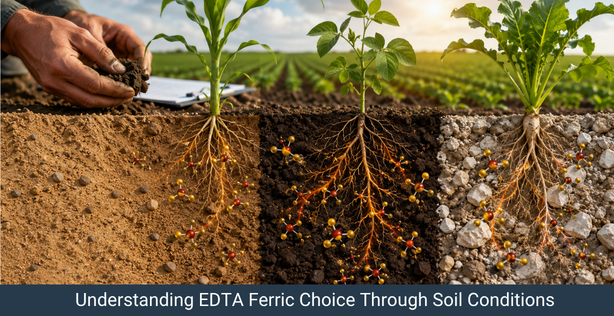
Iron is abundant in most soils yet frequently unavailable to plants, and the chelate a grower selects to fix that gap depends almost entirely on the soil beneath the crop. EDTA Ferric is a highly effective iron source in the right ground and a wasted investment in the wrong one. This guide equips agronomic buyers, distributors, and global agencies with a soil driven framework for deciding when ferric EDTA is the correct iron chelate and when the soil is signalling for a different solution.
Understanding the Ferric Sodium EDTA Iron Source
EDTA Ferric is the iron three complex of Ethylenediaminetetraacetic Acid, sold under several names that appear across supply contracts and regulatory documents. Recognising them prevents confusion at the point of purchase:
| Name | Context |
| Ferric sodium EDTA | Common agricultural trade name |
| Sodium feredetate | Pharmacopoeia and supplement listings |
| Iron three EDTA | Chemical literature |
| Fe EDTA | Shorthand in fertilizer specifications |
| NaFeEDTA | Formula based abbreviation |
The compound carries iron in a soluble, protected form and typically supplies a high iron percentage relative to other iron chelates, which makes it attractive on a cost per unit of iron basis. Its performance, however, is governed by a single decisive variable, and that variable is soil pH.
Why Soil pH Governs Iron Chelate Selection
The central rule of iron nutrition is that iron availability collapses as soil turns alkaline. In acidic and neutral ground iron stays relatively soluble, but as pH climbs, iron precipitates into insoluble hydroxides that roots cannot absorb, producing the yellow leaved condition known as iron chlorosis. A chelate protects iron from this fate only as long as the chelate itself remains stable at the prevailing pH. EDTA holds iron securely in acidic to neutral conditions but begins to release its grip as the soil becomes alkaline, at which point the freed iron precipitates and the treatment fails. This single mechanism explains why EDTA Ferric is not a universal iron source but a soil specific one, and why matching it to pH is the whole art of choosing it correctly.
Our Other Product
EDTA Copper (Ethylenediaminetetraacetic Acid Copper)Matching EDTA Ferric to the Soil pH Band
The practical decision reduces to reading the soil test and placing the field in the correct band. The table below translates soil reaction into a clear recommendation:
| Soil pH band | Soil character | EDTA Ferric suitability |
| Below 6.5 | Acidic | Excellent, iron stays available and the chelate is fully stable |
| 6.5 to 7.0 | Slightly acidic to neutral | Very good, dependable iron delivery |
| 7.0 to 7.5 | Neutral to mildly alkaline | Workable with careful timing and repeat application |
| Above 7.5 | Alkaline or calcareous | Poor, the chelate breaks down and a stronger iron chelate is required |
For soils sitting below neutral, EDTA Ferric is often the most economical and effective iron correction available. For soils above the mildly alkaline threshold, the money spent on it largely washes away as precipitated iron.
Reading Beyond pH: Other Soil Factors That Influence the Choice
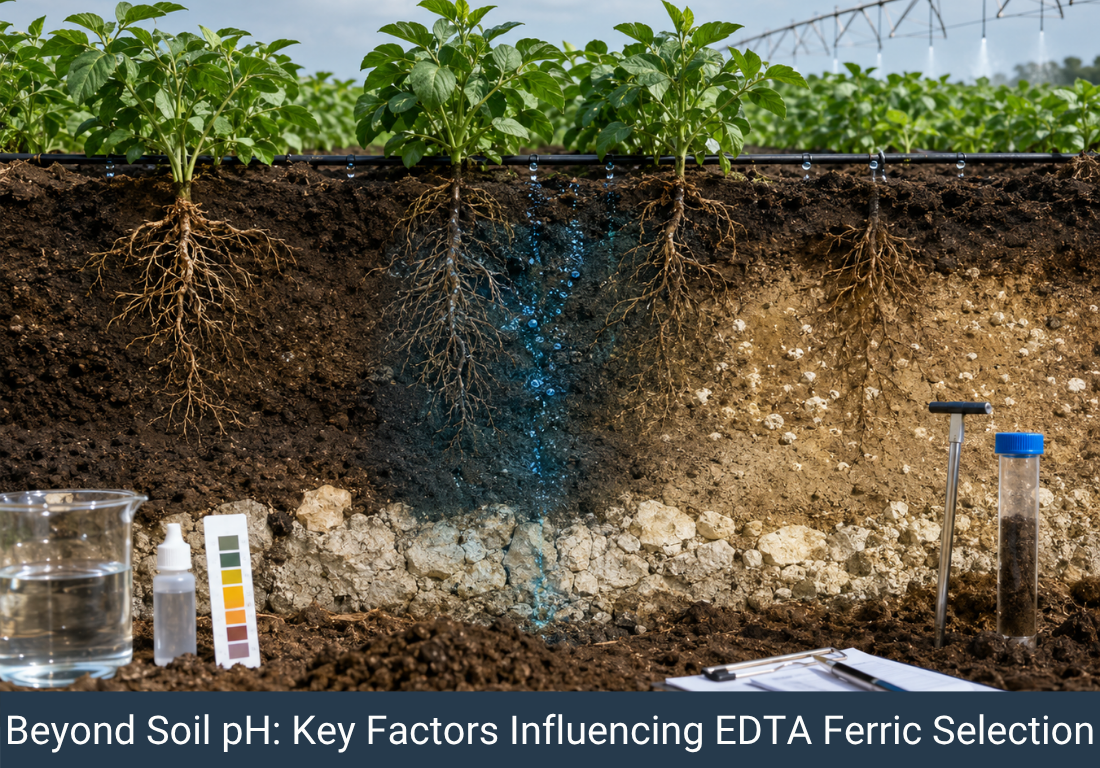
Soil pH is the headline, but several supporting conditions refine the decision and should be weighed together:
- Free lime or calcium carbonate content pushes effective alkalinity higher than pH alone suggests, narrowing the case for EDTA Ferric even near neutral readings.
- Bicarbonate rich irrigation water gradually raises root zone pH, so a soil that tests acidic can behave alkaline in practice under such water.
- High phosphate levels aggravate iron lockup and can worsen chlorosis, increasing the value of any protected iron source in suitable pH ground.
- Soil texture and organic matter affect how long applied iron persists, with sandy low organic soils needing more frequent, well timed applications.
- Salinity and competing cations can stress iron uptake, making a reliable, soluble chelate more valuable within its stable pH range.
Our Other Product
EDTA Manganese (Ethylenediaminetetraacetic Acid Manganese)Delivery Method and Timing for Ferric EDTA
Once the soil qualifies, the application route determines results. EDTA Ferric performs well through soil application and fertigation in acidic to neutral ground, moving with irrigation water to the root zone where uptake occurs. Foliar sprays offer a fast, short term correction of visible chlorosis but do not resolve the underlying soil supply, so they are best paired with root zone delivery. Timing matters: applying at early growth stages and at the first sign of interveinal yellowing prevents yield loss, while split applications sustain availability in leaching prone soils. Buyers advising growers should pair the product recommendation with this delivery guidance to ensure the chelate performs to its potential.
When the Soil Points Away From EDTA Ferric
A responsible iron strategy includes knowing the limits of the product. When a soil test returns a pH above the mildly alkaline threshold, is heavily calcareous, or is irrigated with strongly bicarbonate water, EDTA Ferric will not hold iron long enough to help, and forcing it wastes both product and season. Those conditions call for a chelate engineered to survive high pH, which is where iron EDDHA takes over. Distributors serving mixed territories benefit from stocking both, matching EDTA Ferric to acidic and neutral ground and the high pH stable chelate to alkaline and calcareous fields. Shivam Agro Industries manufactures and exports EDTA Ferric alongside a full range of iron chelates, enabling global buyers and agencies to supply the right iron source for every soil condition their growers face, backed by consistent specifications and export ready documentation.