


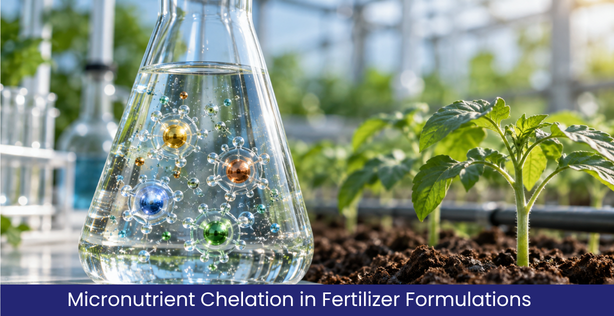
Zinc, iron, manganese and copper are needed in small amounts, yet each can precipitate in the tank, the fertigation line or the soil. Chelation, the binding of a metal ion inside a ring forming molecule, helps keep these metals in solution. Selecting an EDTA chelate therefore means matching the metal, formulation conditions and application route, not just metal concentration.
Role of EDTA Chelates in Micronutrient Stability
EDTA holds a metal ion through four carboxylate and two amino groups, limiting reactions with hydroxide, carbonate and phosphate that would precipitate it. This keeps EDTA chelated micronutrients dissolved in concentrated stocks and blends. Among the metals discussed here, EDTA binds ferric iron (Fe³⁺) more strongly than copper or zinc, while calcium and magnesium bind far more weakly, so metal EDTA chelates differ in how they hold up in mixed solutions.
At sufficiently low pH, protonation of EDTA can reduce metal binding; the extent depends on the metal and solution conditions. At higher pH, hydroxide can attach to iron EDTA, and abundant calcium or magnesium can compete for EDTA. A specification pH reflects test conditions, not the finished EDTA chelate fertilizer, so confirm it when comparing grades from a chelated micronutrient manufacturer.
How Agricultural Chelates Reduce Micronutrient Fixation
In soil, unchelated metals can precipitate as hydroxides and oxides or adsorb onto clay, organic matter and oxide surfaces. Soil pH, aeration and mineral composition influence these reactions. Iron solubility commonly declines under aerobic, alkaline conditions, while manganese and zinc availability can also decrease as pH rises.
Agricultural chelates reduce these losses only while the complex holds. Iron EDTA is generally suited to acidic soils, with effectiveness declining above approximately pH 6.5. Calcareous or alkaline soils may require a more suitable iron chelate. Shivam Agro Industries also offers Fe EDDHA for these conditions, which is more stable above pH 7.
EDTA Chelated Micronutrients Used in Fertilizer Manufacturing
Shivam Agro Industries manufactures EDTA chelates of zinc, iron, manganese and copper, each with its own formulation consideration.
EDTA chelate | Micronutrient supplied | Relevant formulation consideration |
EDTA Ferric | Iron | Light sensitive in solution |
EDTA Zinc | Zinc | In multinutrient blends, confirm zinc stays chelated alongside more strongly bound metals |
EDTA Manganese | Manganese | Assess performance by application route; soil metal exchange can limit effectiveness |
EDTA Copper | Copper | Used at low rates; verify uniform distribution in dry blends |
Liquid, Foliar and Fertigation Formulation Considerations
In liquid products, light is a storage variable. Lamp light caused commercial iron EDTA fertilizer solutions to lose both chelate and soluble iron, forming an iron rich precipitate, while containers that blocked light kept them stable (Albano and Miller, 2001).
Foliar products are diluted shortly before spraying, often in hard water. Whether a chelated or inorganic form performs better depends on formulation, crop, concentration and spray conditions; the chelate’s main role is keeping the metal in solution through dilution and tank mixing.
In fertigation, chelated iron is generally preferred because precipitated metal is lost in tanks, injectors and lines. These systems also allow pH, water hardness and light exposure to be monitored.
A practical evaluation connects these factors. A liquid blend of zinc, iron, manganese and copper EDTA is first prepared at stock concentration and checked for dissolution and clarity over the planned holding period.
The stock is then diluted at the target rate in the actual irrigation water, observed for haze or precipitation, and tested for soluble metal before and after holding. This shows whether the formulation maintains soluble metal content under the tested preparation and holding conditions.
Metal Content, Solubility and Plant Availability
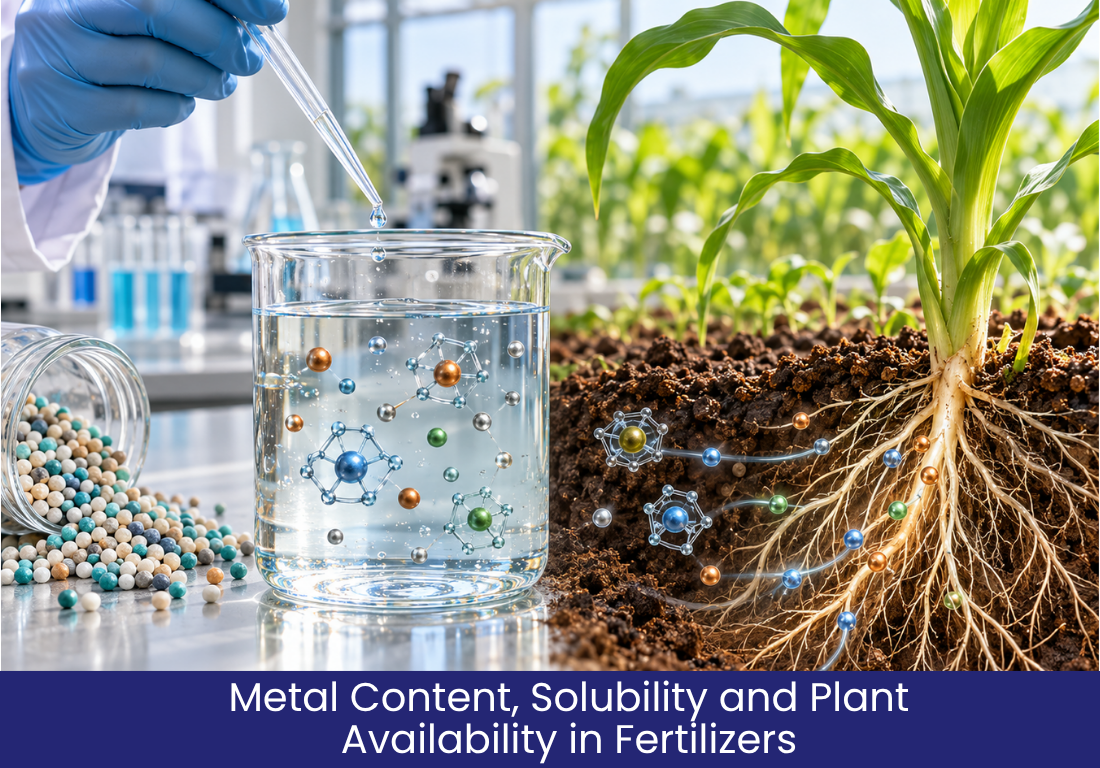
Four measures are easily confused: total metal in the product, soluble metal in the prepared solution, chelated metal still held by EDTA, and crop response.
A clear solution suggests dissolution, but analytical testing is needed to confirm soluble and chelated metal content; appearance alone does not establish plant availability.
Uptake mechanisms vary by metal and plant species, so a chelate supports availability mainly by keeping the metal soluble until it reaches the root zone or leaf surface.
The best form also varies. In some soil studies, manganese sulfate outperformed chelated manganese (Schulte and Kelling, University of Wisconsin Extension), and zinc sulfate remains widely used for its solubility and low cost. Shivam Agro Industries’ EDTA chelates, amino acid chelates and sulphate salts let formulators compare forms of the same metal.
Formulation suitability is assessed through bench and production testing; crop response requires agronomic trials. Neither substitutes for the other.
Checks Before Scaling Up a Micronutrient Formulation
Before approving production, close out these checks.
- Specification approval. Confirm declared metal content, reporting definitions and agreed test methods.
- Trial records. Document whether stock and diluted formulations meet your acceptance criteria.
- Dry blend performance. Assess flow, caking, moisture pickup and micronutrient distribution.
- Agronomic evidence. Confirm crop response for the intended application.
- Outstanding questions. Resolve discrepancies before approving production.
About Shivam Agro Industries, a Chelated Micronutrient Manufacturer
Shivam Agro Industries is an Indian manufacturer, exporter and wholesale supplier of EDTA products, amino acid chelates and mineral ingredients for soil and foliar application, fertilizer blending and hydroponics. It serves buyers across India and exports to Asia, the Middle East, Africa, Europe and the Americas, with COA, MSDS and customs documentation.
Its range covers EDTA Acid, Disodium and Tetrasodium; EDTA chelates of zinc, iron, manganese, copper, calcium and magnesium; Fe EDDHA; glycinates of zinc, copper, manganese, magnesium, calcium, iron, potassium, selenium, chromium and cobalt; and Zinc Sulfate Monohydrate 33% and 36%, Dried Ferrous Sulphate, Copper Sulphate, Magnesium Sulphate Anhydrous and Glycine. That breadth supports the comparisons in this guide.
Conclusion: Choosing the Right EDTA Chelate
The right EDTA chelate suits the formulation pH, water, ingredients, storage and application route, confirmed through bench, production and agronomic evaluation. When requesting specifications from Shivam Agro Industries, share your target metal content, formulation type, dilution water conditions and application route.