


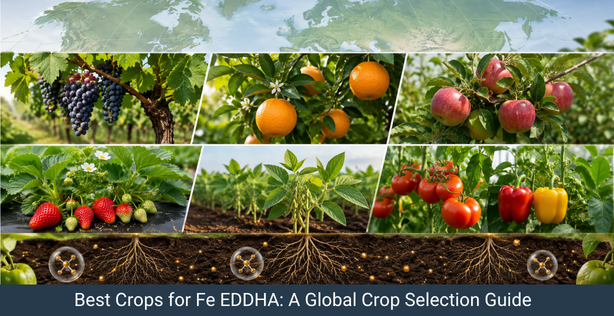
Iron chlorosis does not strike every crop equally. Some plants are notoriously sensitive to iron shortage on alkaline soil, turning yellow and losing yield while hardier neighbours stay green. Fe EDDHA, the high pH stable iron chelate, delivers its greatest return on exactly these vulnerable, high value crops. This crop by crop matrix helps importers, distributors, and global agencies target the growers who need iron EDDHA most, and who will pay for the yield and quality it protects.
How Iron Sensitivity Shapes the Target Crop List
Crops differ in how efficiently their roots extract iron from difficult soil, and the poor extractors are the natural market for a premium iron chelate. High value fruit, vine, and horticultural crops dominate this list because their economics justify the investment and because chlorosis directly damages the marketable product through smaller fruit, pale foliage, and weaker vigour. The crop groups below represent the strongest and most reliable demand for Fe EDDHA across the world’s calcareous growing regions, organised by category so that a distributor can map the product to the customers in its territory.
Fruit Orchards That Respond Strongly to Iron EDDHA
Deciduous and subtropical fruit trees are among the most iron hungry crops on alkaline ground, and orchardists are typically well informed, high value buyers.
|
Crop |
Why Fe EDDHA matters |
|
Citrus such as orange, lemon, and mandarin |
Highly chlorosis prone on calcareous soil, iron protects fruit set and rind quality |
|
Peach, nectarine, and apricot |
Classic iron sensitive stone fruit that yellows badly without stable iron |
|
Apple and pear |
Benefit from corrected iron for leaf health, vigour, and fruit sizing |
|
Pomegranate |
Grown widely on high pH soils where iron availability limits yield |
|
Avocado |
Sensitive to iron shortage, with chlorosis reducing canopy and crop |
Across these orchards, root zone Fe EDDHA applied through irrigation early in the season prevents the interveinal yellowing that otherwise cuts into both yield and fruit grade.
Our Other Product
EDTA Tetrasodium (Ethylenediaminetetraacetic Tetrasodium)Vineyards and Berry Plantations Prone to Lime Induced Chlorosis
Grapevines and berry crops planted on limestone rich and calcareous soils suffer a well documented condition called lime induced chlorosis, making them a premier market for iron EDDHA.
- Wine and table grapevines on calcareous terroir, where iron deficiency weakens shoots and reduces bunch quality, respond markedly to a stable iron chelate.
- Strawberries in high pH substrates and soils show rapid green up and better runner and fruit development with corrected iron.
- Blueberries, which demand acidic conditions, struggle acutely when soil pH drifts upward, and benefit from a chelate that survives that stress.
- Raspberries and other cane berries maintain vigour and yield when iron is kept available through the root zone.
For these perennial plantings, a single well timed soil application of a high ortho ortho grade sustains iron supply through the critical growth window.
High Value Vegetables Grown Under Intensive Systems
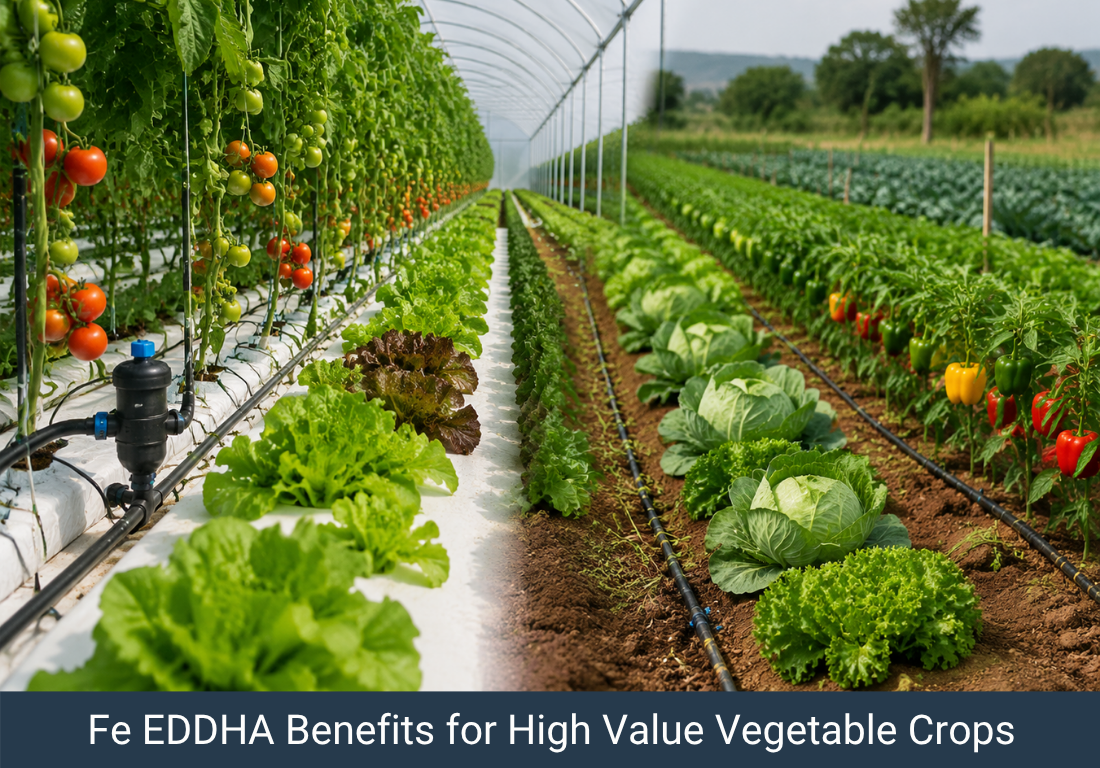
Protected and open field vegetable growers, especially those using fertigation, are efficient adopters of Fe EDDHA because their systems deliver it precisely and their crops reward the input quickly.
|
Vegetable |
Iron EDDHA benefit |
|
Tomato |
Prevents chlorosis in greenhouse and field crops, protecting fruit set |
|
Pepper and chilli |
Maintains leaf colour and photosynthetic capacity for higher yield |
|
Cucumber and melon |
Sensitive cucurbits that green up fast under fertigated iron |
|
Leafy greens |
Benefit directly since leaf colour is the marketable trait |
|
Potato |
Responds to corrected iron on alkaline ground for canopy and tuber development |
Because these crops cycle quickly and are often grown hydroponically or through drip, the clean solubility of Fe EDDHA makes it the practical iron source of choice.
Ornamentals, Turf, and Nursery Stock
The horticultural and amenity sector is a steady, quality driven market where visible leaf colour is the entire product.
- Ornamental flowering plants and potted stock, where any yellowing destroys sale value, rely on stable iron for pristine foliage.
- Roses and acid loving ornamentals such as azalea, camellia, and gardenia show iron chlorosis readily on unsuitable soil and respond well to EDDHA iron.
- Turf on golf courses, sports fields, and premium lawns uses iron for deep colour and density, with the high pH stable chelate performing where soils or irrigation water are alkaline.
- Nursery and landscape stock benefit from consistent iron nutrition that keeps plants saleable and vigorous.
Our Other Product
EDTA Zinc (Ethylenediaminetetraacetic Acid Zinc)Field and Plantation Crops on Problem Soils
While iron EDDHA is most associated with high value horticulture, several broad acre and plantation crops on calcareous soils also justify it, particularly where chlorosis causes measurable yield loss.
|
Crop |
Situation favouring Fe EDDHA |
|
Groundnut |
Prone to iron chlorosis on calcareous soils, a well known deficiency crop |
|
Soybean |
Suffers iron deficiency chlorosis on high pH ground, reducing pod fill |
|
Sugarcane |
Long duration crop benefiting from sustained iron on alkaline soils |
|
Banana |
Heavy feeder that maintains vigour and bunch quality with corrected iron |
Turning the Crop Matrix Into Market Reach
The pattern across every category is consistent: the crops that benefit most from Fe EDDHA are high value, iron sensitive plants grown on alkaline and calcareous soils, and they span orchards, vineyards, intensive vegetables, ornamentals, and select field crops. A distributor who maps this matrix onto the growers in its region can target demand precisely rather than selling iron generically. Shivam Agro Industries manufactures and exports Fe EDDHA with a dependable ortho ortho specification suited to all of these crops, supplying bulk importers and global agencies with a consistent, high pH iron chelate so that partners can serve citrus growers, viticulturists, vegetable producers, and plantation managers worldwide from one reliable Indian source.