


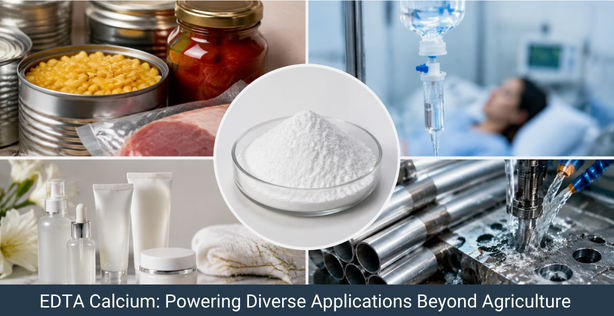
Most trade conversations frame EDTA Calcium as a foliar nutrient, yet its largest and most valuable markets sit entirely outside the farm. The calcium disodium salt of Ethylenediaminetetraacetic Acid is a workhorse across food preservation, human medicine, cosmetics, and heavy industry, where it performs a single elegant trick in countless settings: it captures and neutralises reactive metal ions. This article traces where EDTA Calcium travels once it leaves agriculture, giving global importers a fuller picture of the demand behind the product.
One Molecule, Many Names Around the World
Before mapping applications, buyers should recognise the aliases EDTA Calcium wears in different industries and countries, because purchase specifications and regulatory filings often use these names interchangeably:
| Name | Where it appears |
| Calcium disodium EDTA | General chemical and food trade |
| Calcium disodium edetate | Pharmacopoeia and pharmaceutical labels |
| Sodium calcium edetate | European and Commonwealth medical use |
| E385 | European food additive number |
| Calcium disodium edetate versenate | Clinical chelation therapy |
| Edetate calcium disodium | United States pharmacopoeia listing |
Food Preservation and the E385 Additive Function
In the global food industry EDTA Calcium is registered as additive E385, where it protects flavour, colour, and freshness by locking away the trace metals that trigger spoilage. Iron and copper ions naturally present in food catalyse oxidation that turns fats rancid, browns cut surfaces, and fades pigments. By sequestering those metals, the additive extends shelf life and preserves appearance in a defined list of products. Its typical roles include the following:
- Stabilising colour and preventing discolouration in canned vegetables, pulses, and mushrooms.
- Preserving flavour and preventing rancidity in mayonnaise, salad dressings, sauces, and spreads.
- Protecting canned seafood and shellfish against struvite crystal formation and metal driven off flavours.
- Maintaining clarity and taste in soft drinks and preventing oxidation in dressings and emulsified products.
Food grade EDTA Calcium must meet strict purity, arsenic, and heavy metal limits set by international food codes, so bulk food buyers demand a manufacturer able to certify each batch to food specification.
Medical Use as a Lead and Heavy Metal Chelator
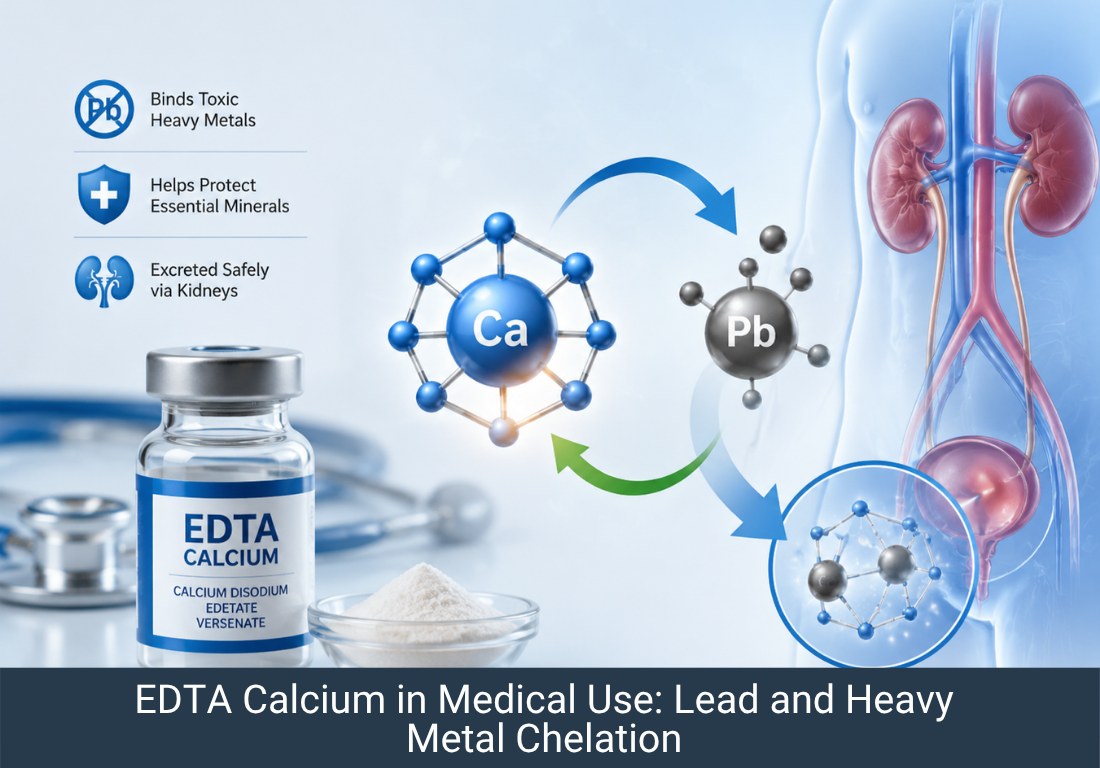
The most striking application of EDTA Calcium is inside human medicine, where under the name calcium disodium edetate versenate it is a frontline treatment for lead poisoning. The principle is a controlled metal exchange: the loosely held calcium inside the chelate swaps places with the far more tightly bound lead circulating in the patient, and the resulting stable lead complex is excreted through the kidneys. Because the drug already carries calcium, it removes toxic heavy metals without stripping the body of its own calcium, which distinguishes it from more aggressive chelators. It is used in acute lead intoxication and in exposure to certain other heavy metals under clinical supervision. This pharmaceutical role demands the highest purity grade and rigorous regulatory documentation, representing a small volume but high value slice of global demand.
Our Other Product
Chromium GlycinateCosmetics and Personal Care Stabilisation
Personal care manufacturers add EDTA Calcium to protect formulations from the destabilising effect of metal ions introduced through water, raw materials, and packaging. In shampoos, soaps, lotions, and skin creams it prevents metal catalysed spoilage, preserves fragrance and colour, and improves the performance of preservatives and foaming systems. It also counters the way hard water metals interfere with cleansing, helping products lather and rinse consistently regardless of local water quality. For brands exporting across regions with widely varying water chemistry, this consistency is a quiet but crucial selling point, and the chelate delivers it at low inclusion levels.
Industrial Cleaning, Water, and Heavy Sectors
Across heavy industry EDTA Calcium serves wherever metal ions must be controlled without introducing the stronger sequestering power, or higher cost, of other edetate salts. Its industrial footprint spans several sectors:
| Sector | Function of EDTA Calcium |
| Industrial cleaning | Sequesters hardness and metals in detergents and descalers |
| Pulp and paper | Assists metal control in bleaching and processing water |
| Textiles | Manages metal interference in dyeing and finishing |
| Water treatment | Controls scale forming and staining metal ions |
| Oil and gas | Aids scale dissolution and metal management in well fluids |
| Rubber and polymer | Acts as a stabiliser against metal catalysed degradation |
Our Other Product
Cobalt GlycinateWhy Sector Diversity Matters for Bulk Buyers
The breadth of these applications gives EDTA Calcium unusually resilient, non seasonal demand, which benefits both suppliers and importers planning long term contracts. A buyer who understands that a single product can be routed to food, pharmaceutical, cosmetic, and industrial customers can consolidate volume, negotiate better freight economics, and hedge against the seasonality that pure agricultural inputs face. Shivam Agro Industries supplies EDTA Calcium across food, technical, and specialised grades to importers, formulators, and global agencies, matching each grade and its documentation to the destination industry so that international buyers can serve multiple end markets from one dependable Indian source.