Choosing an EDTA Zinc manufacturer involves more than comparing price or a single zinc percentage on a quotation. The value of chelated zinc depends on raw material selection, how the EDTA Zinc production process is controlled, and how the finished material is verified before release.
Shivam Agro Industries supplies chelated micronutrients to buyers who formulate fertilizers and specialty nutrient products. Understanding these production fundamentals helps technical teams ask sharper questions during evaluation.
This article explains the chemistry, production stages, and quality checks that shape a dependable chelated zinc product.
How Chelation Forms EDTA Zinc
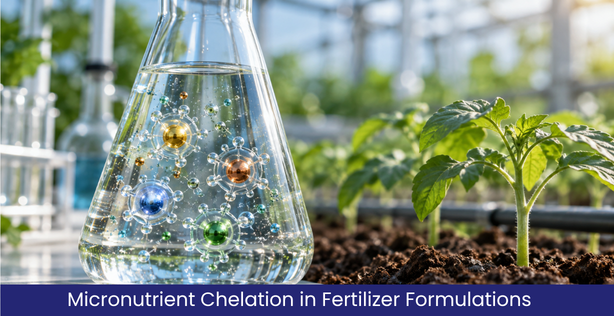
Chelation is the process by which an organic molecule binds a metal ion through multiple coordination points, forming a ring shaped complex that holds the metal in a soluble, stable form. Ethylenediaminetetraacetic acid, known as EDTA, offers several binding sites that surround a zinc ion tightly.
In Zinc EDTA manufacturing, this bonding is what separates a true chelate from a simple physical blend of zinc salt and EDTA powder. Mixing the two without the correct reaction leaves unreacted or loosely associated zinc, which behaves differently in soil and tank mixes than zinc held inside a completed EDTA ring.
The EDTA to zinc ratio and the chemical forms of the reactants determine how much zinc ends up as the intended Zn EDTA complex rather than as free or precipitated zinc. This is why a chelated micronutrient manufacturer treats reactant ratio and purity as production variables rather than fixed assumptions.
EDTA Zinc differs from inorganic sources such as zinc sulfate or zinc oxide because the chelate structure protects the zinc ion from reacting with soil components that would otherwise reduce its availability to plants.
Raw Materials in Zinc EDTA Manufacturing
Production starts with identifying the zinc source and EDTA source used in the chosen route. Zinc may be introduced as zinc sulfate, zinc oxide, or another zinc salt, while EDTA may be supplied as the free acid or as a sodium salt.
The chemical form matters because it influences the reaction conditions needed and the byproducts generated. Buyers assessing an EDTA Zinc supplier should ask how reactant concentration and impurity profiles are controlled during manufacturing, since heavy metals such as lead, cadmium, and arsenic are commonly restricted in agricultural grade specifications.
Water quality used during dissolution also matters, since dissolved minerals or contaminants in process water can interfere with complex formation. Supplier documentation, including certificates of analysis for incoming zinc and EDTA, lets a plant confirm each raw material batch before it enters production.
Traceability between accepted lots and finished batches supports later quality investigations. Buyers evaluating Shivam Agro Industries can request information about the raw material controls relevant to the offered EDTA Zinc grade.
EDTA Zinc Production Process: Main Stages
A general Zn EDTA production sequence follows several conceptual stages, though not every route uses every operation below, and some steps are route dependent.
- Preparing the reactants, dissolving or measuring the zinc and EDTA sources to the concentrations the reaction requires.
- Controlled addition and mixing, introducing one reactant into the other under agitation so contact stays even across the batch.
- Maintaining suitable reaction conditions such as pH and temperature that favor complex formation over side reactions.
- Monitoring pH to support reaction control, with the endpoint assessed using an appropriate analytical method rather than inferred from pH alone.
- Separation or purification, used in some routes to remove excess reactants or byproducts not consumed in the reaction.
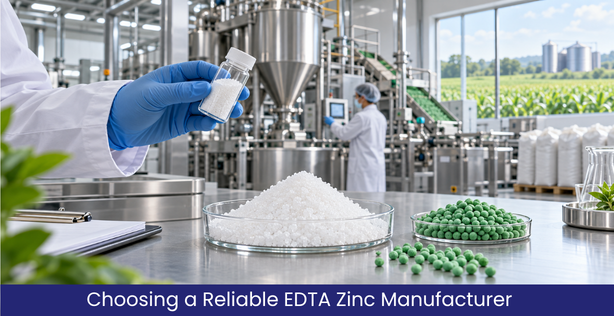
- Producing the specified finished form, typically a dried powder or granular material matching the stated product form.
- Packing and identifying the batch with a lot number that links the packaged material to its production record.
Drying removes moisture and produces the stated physical form, but it does not by itself establish chemical purity.
Filtration separates solids from liquids without removing dissolved impurities that remain in solution.
EDTA Zinc Quality Testing Before Batch Release
Quality verification includes checks during production to guide process decisions and testing of the finished batch before release. Agricultural grade chelated zinc is typically assessed for zinc content, pH and insoluble matter.
Buyers should establish whether the reported zinc percentage refers to total zinc, water soluble zinc or zinc held in chelated form. Each result should identify its measurement basis and test method, since a zinc percentage alone should not be presented as proof of complete chelation.
| Parameter | What it indicates | Confirm with supplier |
|---|---|---|
| Zinc content, reporting basis (total, water soluble, or chelated) | Which form of zinc the reported figure represents | Measurement basis and test method |
| pH, defined solution strength | Solution behavior under stated conditions | Measurement basis and range |
| Moisture and insoluble matter | Moisture level and material remaining undissolved under the test conditions | Separate limits and test methods |
A specification limit describes what a material must meet to pass release testing, while an actual batch result is the measured value for that lot, and the two should not be treated as identical. A certificate of analysis connects a tested result to a batch number, documenting what was tested against what was shipped.
Appearance and solution clarity are useful visual checks, but they do not confirm complete chelation or purity on their own, since a clear solution can still contain unchelated zinc.
EDTA Zinc Stability After Production
EDTA Zinc storage and formulation compatibility require separate evaluation. Moisture exposure can affect powder handling, so packaged material should be protected according to the supplier’s storage instructions.
Shelf life and storage conditions should be taken from the documentation for the supplied grade.
Once dissolved, compatibility should be assessed using the intended water source, solution pH, mixing concentration and other formulation ingredients. A trial under the buyer’s actual conditions helps assess suitability beyond the release specification.
Any stated compatibility limits should be supported by product specific information or testing.
Choosing an EDTA Zinc Supplier: What to Confirm
Before approving a shipment, buyers should confirm the exact specification with Shivam Agro Industries directly, including the zinc content basis and physical form required for the intended application, rather than relying on a general product description.
It is worth asking whether the evaluation sample represents the same batch, process, and specification as the material intended for the full order.
It also helps to agree in advance on how changes to the material, such as a shift in raw material source or process, will be communicated. Identifying a specific contact for unresolved technical questions streamlines the approval process.
About Shivam Agro Industries, EDTA Zinc Manufacturer
Shivam Agro Industries is a manufacturer and supplier of EDTA products and chelated micronutrients based in Ranasan G.I.D.C., Vijapur, Gujarat. Its range includes EDTA Zinc, EDTA Acid, EDTA Disodium, EDTA Tetrasodium, and EDTA chelates of copper, manganese, magnesium, calcium and iron.
The company also offers glycine chelates and related chemical products for buyers sourcing agricultural and industrial ingredients.
Conclusion on EDTA Zinc Manufacturing Quality
EDTA Zinc manufacturing quality depends on appropriate raw materials, controlled chelation, suitable finishing and meaningful release testing. Understanding these stages helps buyers evaluate how the finished material is produced and what its reported results establish.
Shivam Agro Industries welcomes enquiries that include the required specification, intended application, order quantity, and delivery location, so the company can respond with information matched to the buyer’s actual requirement.