EDTA Chelate Applications Beyond Agriculture
The EDTA chelate category is best known for micronutrient fertilizers, yet the same chemistry appears in pulp mills, dye houses, cleaning formulations and regulated food processing.
Entering these areas is not a matter of relabelling an agricultural material, and a technically sound use does not automatically become a viable market. Shivam Agro Industries manufactures EDTA acid, its sodium salts and several metal EDTA chelates in Gujarat, so its buyers face a practical question: which form fits the job, and is the opportunity worth qualifying?
EDTA Chelating Agents Versus Preformed Metal EDTA Chelates
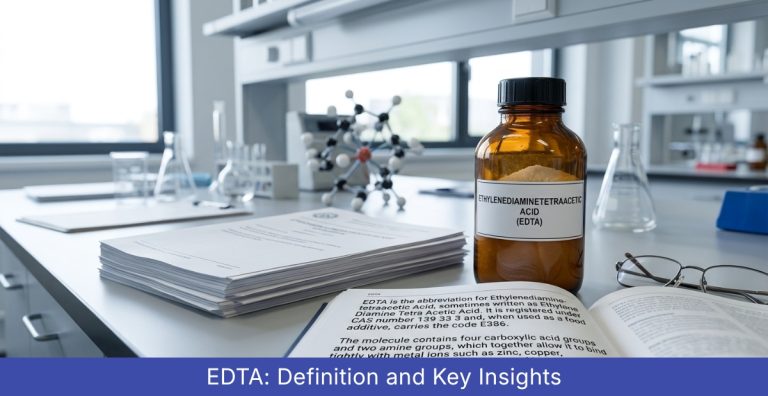
Chelation is the binding of a metal ion by a molecule that grips it at several points at once. EDTA (ethylenediaminetetraacetic acid) holds a metal through two nitrogen atoms and four carboxylate groups, forming a stable, water soluble complex that keeps the metal from reacting as a free ion.
Buyers encounter both uncomplexed EDTA chelating agents and preformed metal EDTA chelates. EDTA acid and its sodium salts belong to the first group: they enter a process with free binding capacity and capture calcium, magnesium, iron or other ions that would otherwise cause trouble.
A preformed metal EDTA chelate, such as ferric or zinc EDTA, arrives with its metal already bound, and its purpose is to deliver that metal in soluble form. It should not be treated as a substitute for an uncomplexed reagent when the goal is controlling unwanted ions.
Binding strength also varies with the metal and with pH, so process conditions decide whether either form performs. The wider family of industrial chelates includes DTPA, EDDHA, glycinates and phosphonates, which behave differently and are not interchangeable with EDTA compounds.
A buyer approaching a specialty chemicals supplier therefore needs to state the exact compound, its hydration state and whether the aim is to bind metals or to supply one.
Agricultural EDTA Chelates as a Reference Point
In crop nutrition, preformed metal EDTA chelates keep micronutrients soluble for foliar sprays, fertigation and hydroponic solutions.
As an EDTA compounds manufacturer, Shivam Agro Industries offers EDTA Ferric with 12% chelated iron for crop iron deficiency and EDTA Calcium as a chelated calcium source for horticulture. Both are specified for fertilizer performance, which is why their suitability elsewhere must be established separately.
Industrial Chelates: Where Each EDTA Form Applies
The following groups distinguish process uses of EDTA chelating agents, potential uses of preformed metal chelates and applications requiring separately qualified grades.
Applications Using EDTA Chelating Agents
These uses rely on uncomplexed EDTA or its sodium salts to control metal ions already present in a process.
Pulp and paper bleaching. Manganese, iron and copper in pulp react with hydrogen peroxide, forming radicals that waste the bleaching chemical and attack cellulose. Many mills add a chelation stage, commonly labelled Q, in which EDTA or DTPA binds these metals so they can be washed out before peroxide bleaching.
The metals are not destroyed; they leave in the wash filtrate, so effluent handling needs its own assessment, and stage pH and temperature must suit each pulp.
Textile wet processing. Calcium and magnesium from process water, together with metals naturally present in cotton and wool, form insoluble soaps and interfere with dyes, causing uneven shades between batches. EDTA salts keep these ions dissolved and inactive in the bath.
Shivam Agro Industries names textile and dyeing among the stated application areas for EDTA Disodium and identifies EDTA Tetrasodium as better suited to alkaline work such as scouring. Dosage should follow the hardness and trace metal load measured in the mill.
Industrial cleaning. Hardness ions reduce detergent action and leave deposits, and the company positions its tetrasodium salt for industrial and household cleaning formulations.
Industrial cleaner evaluation should include cleaning performance, ingredient compatibility and the handling of the resulting wastewater. Buyers should assess these requirements for their own formulation and operating site.
Preformed Ferric EDTA in Food Fortification Manufacturing
Food fortification provides an application of a preformed metal EDTA chelate beyond agriculture. Ferric sodium EDTA supplies iron as an existing complex, serving a different purpose from sodium EDTA salts used to capture unwanted metal ions. Shivam Agro Industries discusses fortified foods and dietary supplements among the uses of its EDTA Ferric.
Manufacturers evaluating this application should confirm the exact chemical identity, required food grade, iron specification and supporting documentation. A fertilizer specification alone does not establish suitability for food manufacturing. Buyers should request confirmation from Shivam Agro Industries that the offered material meets their intended application and destination requirements.
Opportunities Requiring a Separately Qualified Grade
Chemical identity must be checked separately from grade designation. Calcium disodium EDTA and agricultural EDTA Calcium should not be treated as equivalent products. Buyers should verify the named compound against the specification required for their intended use.
Buyer Checks for EDTA Compounds in Specialty Formulations
Formulators in personal care, paints, polymers and water treatment must validate an EDTA compound inside their own system, because general data cannot predict its behaviour among other ingredients.
An EDTA compounds manufacturer or specialty chemicals supplier can only offer the right material when the application brief is clear. The checks below consolidate what that brief should cover.
| Formulation requirement | Why it matters | What the buyer should verify |
|---|---|---|
| Chemical identity and hydration state | Acid, disodium dihydrate and tetrasodium forms differ in molecular weight, solubility and solution pH | CAS number, formula and water content on the specification |
| Formulation pH and competing ingredients | Binding strength shifts with pH, and excess ions can displace weaker complexes | Performance at the actual pH and ion load of the formulation |
| Concentration and dissolution | EDTA acid dissolves poorly in water until neutralised, while sodium salts dissolve more readily | Dissolution at the intended dose, temperature and mixing conditions |
| Application relevant impurities | Trace metals and other residues can matter in sensitive end uses | Limits and test methods suited to the target market |
| Grade and documentation | Industrial or fertilizer specifications do not establish suitability for regulated uses | Certificate of analysis, applicable standard and supporting documents |
| Effects on the finished product | Bound metals remain in the product or process stream | Stability, appearance and behaviour in later processing steps |
Evaluating EDTA Chelate Market Opportunities
Knowing that EDTA works in a process is only the first filter. Whether that use becomes a commercial opportunity for EDTA chelate suppliers, distributors or exporters depends on five further tests.
A defined customer problem. Opportunities are clearer when they start from a specific failure, such as manganese disrupting a mill’s peroxide stage or iron spotting in a dye house, rather than a broad label like “the paper industry”.
A defined problem tells the seller which form is needed and which competing solution it must beat.
Availability of the required compound and grade. The next question is whether the exact salt, chelate and grade that problem needs can be supplied consistently.
A sodium salt offered for cleaning does not cover a request needing a documented regulated grade, and a fertilizer chelate does not cover an industrial specification with tighter impurity limits.
Qualification work and supporting evidence. Many industrial and regulated customers require samples, plant or formulation trials, audits and documentation before approval. These steps take time and money on both sides, so the expected volume must justify them.
A published study showing that EDTA performs in a new setting signals interest, not proven commercial use.
Expected repeat purchasing. Purchasing needs should be estimated from real enquiries, sample requests and customer forecasts. A single trial order does not establish demand, and interest in chelated compounds generally does not prove demand for EDTA chelates specifically.
Distributors comparing EDTA chelate manufacturers in India should look for evidence that a customer will reorder once qualified.
Supply feasibility and qualification costs. Finally, destination regulations, labelling, documentation and logistics must support a workable supply arrangement at a price the application can bear.
When qualification costs exceed the likely margin, a technically valid use is still a poor opportunity.
Shivam Agro Industries can be approached with a defined product requirement and its intended application, so the discussion starts from these tests rather than a generic product name.
About Shivam Agro Industries, EDTA Products Manufacturer
Shivam Agro Industries is an EDTA products manufacturer based at Ranasan GIDC, Vijapur, in the Mehsana district of Gujarat.
The company’s offering includes EDTA Acid and its sodium salts; metal EDTA chelates of zinc, copper, manganese, magnesium, calcium and iron; glycine and glycinate compounds; the separate iron chelate Fe EDDHA; and mineral salts covering ferrous, zinc, copper and magnesium sulphates.
Buyers can use this range to match the required chemical form to their application before raising a sourcing enquiry.
Conclusion on EDTA Chelate Market Opportunities
Potential opportunities beyond agriculture should be evaluated against the required chemical identity, application performance, qualification requirements and supply feasibility. Applications that pass those tests justify sampling and trials; those that do not are better set aside early.
Buyers can send Shivam Agro Industries an enquiry stating the intended application, chemical identity, required specification, quantity and delivery location, so each request is assessed against the right product.