


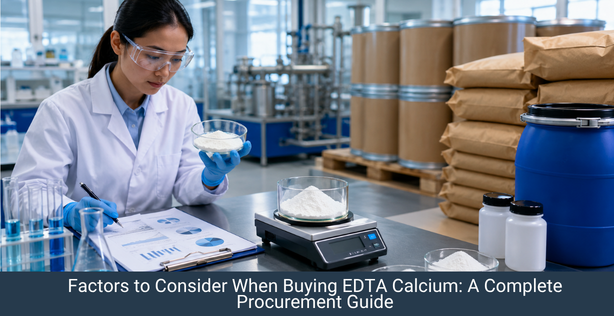
Sourcing EDTA Calcium in bulk is a technical purchase disguised as a commodity order. Two drums labelled identically can differ sharply in chelated calcium content, purity, and regulatory fitness, and the gap only surfaces when a shipment underperforms or fails an inspection at the destination port. This procurement guide walks import managers, blenders, and global agencies through the factors that separate a dependable EDTA Calcium supplier from a risky one, so that price is judged against real delivered value rather than a headline number.
Verifying Chelated Calcium Content and Assay
The first checkpoint is the guaranteed analysis, because the useful part of the product is the calcium actually held within the chelate, not the total powder weight. Reputable manufacturers state the chelated calcium percentage and the assay of the edetate compound, and they back both with a certificate of analysis for the specific lot. Buyers should confirm whether a quoted figure refers to elemental calcium or to the salt, since the two differ substantially and a vague specification often hides a diluted product. A clear, lot specific assay is the single strongest signal that a seller is a genuine producer rather than a repackager blending down higher grade material.
Assessing Chelation Strength and pH Stability Window
Not every calcium product sold as chelated behaves the same in the tank or the process line. Buyers should ask for the effective pH range across which the chelate remains stable and keeps calcium soluble, because a product that precipitates outside a narrow band will disappoint in real conditions. The following practical checks help:
- Request the pH stability window and match it to the water and process the product will meet in use.
- Confirm behaviour in hard water, since calcium chelates must remain clear where competing ions are abundant.
- Ask for solubility data at the concentrations and temperatures the buyer’s blend or bath will require.
- Verify compatibility with the other salts in a target formulation to avoid antagonism and cloudiness.
Checking Purity, Heavy Metals, and Insolubles
For food, pharmaceutical, and premium formulations, contamination limits decide whether a lot is usable at all. A serious specification names the ceilings for arsenic, lead, and other heavy metals, states moisture and water insoluble content, and reports the level of unreacted or free acid. High insolubles clog emitters and leave residue in finished goods, while heavy metal excursions cause outright rejection in regulated markets. Importers serving sensitive end uses should insist on third party or accredited laboratory results rather than accepting a generic house certificate, and should retain retention samples against future disputes.
Matching Product Grade to End Application
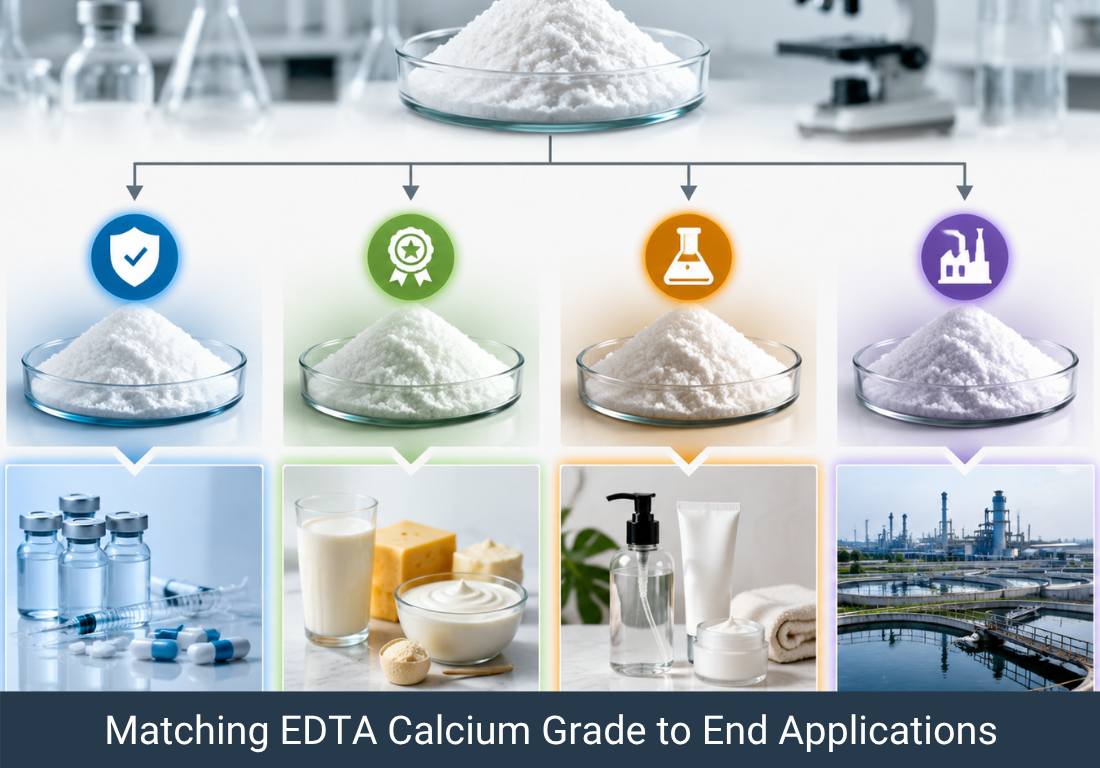
EDTA Calcium is produced in distinct grades, and buying the wrong tier is a common and costly error. The grade governs purity, documentation, and price, and it must align with the destination industry:
| Grade | Suited to | Key requirement |
| Food grade | Food additive E385 uses | Food code purity and heavy metal limits |
| Pharmaceutical grade | Medical and nutraceutical use | Pharmacopoeia compliance and full traceability |
| Technical grade | Cleaning, textile, water treatment | Consistent assay at economical cost |
| Agricultural grade | Foliar and fertigation nutrition | Reliable chelated calcium and solubility |
Paying pharmaceutical prices for a cleaning application wastes margin, while using technical grade in food risks compliance failure, so grade selection is a core procurement discipline.
Our Other Product
Magnesium Sulphate AnhydrousConfirming Certifications and Regulatory Documents
Cross border trade in chelates lives or dies on paperwork, and the right certificates prevent shipments from stalling at customs. Depending on the destination market and end use, buyers should confirm which of the following the supplier can provide:
- Quality system certification such as ISO for consistent manufacturing.
- Food safety credentials such as FSSAI, HACCP, Halal, and Kosher for food grade orders.
- Chemical registration support such as REACH for the European market.
- Safety data sheets, certificates of origin, and any product specific regulatory filing the importer requires.
A supplier who furnishes complete, accurate documentation on request signals both experience and legitimacy, which reduces the hidden cost of clearance delays.
Evaluating Packaging, Shelf Stability, and Order Flexibility
Practical logistics often decide the true cost of a chelate. EDTA Calcium is hygroscopic to a degree, so moisture resistant packaging in appropriately sized bags or drums protects assay and flowability through long ocean transit and humid storage. Buyers should confirm packaging options, palletisation, net weights, and the stated shelf life, and should check whether the supplier accommodates both trial quantities and full container loads. Flexible minimum order quantities let a new importer qualify the product before committing to volume, while reliable large scale capacity matters once demand is proven.
Our Other Product
GlycineJudging the Supplier: Manufacturer Versus Trader
The final factor underpins all the others: whether the counterparty actually manufactures the chelate or merely trades it. A true EDTA Calcium manufacturer controls the reaction, the quality parameters, and the batch records, which means it can customise grade, guarantee consistency, resolve technical queries, and stand behind a certificate of analysis. A pure trader cannot. Buyers evaluating a long term relationship should weigh production capacity, technical support, responsiveness, export track record, and references from comparable markets. Shivam Agro Industries manufactures EDTA Calcium directly and supplies it worldwide as a bulk exporter, offering grade specific documentation, moisture protected export packaging, flexible order sizes, and the technical backing that lets global importers buy with confidence rather than on faith.