



Beyond the field, EDTA Magnesium earns its place inside factories. The same magnesium disodium chelate that stabilises a fertigation line also functions as a precision agent in industrial chemistry, where its job is to hold magnesium ions in solution, buffer reactions, and neutralise interference from stray metals. For process industries and global procurement teams that already know EDTA Magnesium as an agricultural input, this article maps the industrial demand that makes it a year round, multi sector chemical rather than a seasonal one.
Why Industry Reaches for Magnesium Disodium EDTA
Industrial buyers value this chelate for three engineering properties that cut across sectors. First, it delivers magnesium in a fully soluble, non precipitating form that survives wide pH swings inside a reactor. Second, it acts as a sequestrant, mopping up unwanted trace metals that would otherwise catalyse spoilage, discolouration, or side reactions. Third, it introduces magnesium as a functional cofactor without the cloudiness or scaling that raw magnesium salts cause. These traits let a single additive stabilise a formulation, protect a catalyst, and standardise a process, which is why demand extends far past agriculture. The sectors below represent the strongest pull for EDTA Magnesium in bulk.
Textile Processing and Dyeing Applications
Textile mills use EDTA Magnesium as a controlled source of magnesium and as a metal managing auxiliary in dyeing and finishing baths. In reactive and vat dyeing, uncontrolled metal ions distort shade, reduce colour yield, and create uneven uptake across a fabric run. The chelate holds magnesium at a defined level to support certain dye fixation chemistries while sequestering interfering ions, producing repeatable colour batch after batch. It also stabilises peroxide bleaching, where trace metals otherwise trigger uncontrolled decomposition that weakens fibres. For exporters supplying textile hubs across Bangladesh, Vietnam, Turkey, and India, a consistent chelate grade translates directly into fewer reprocessed lots and tighter shade tolerances.
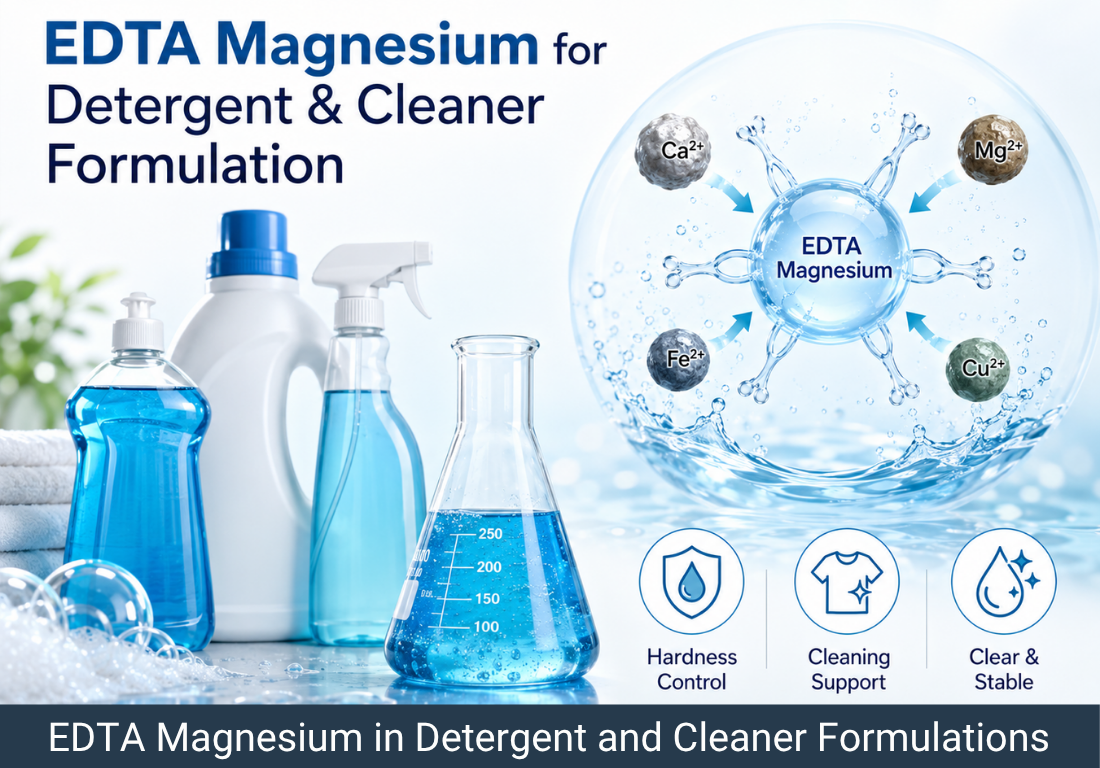
Detergent, Cleaner, and Household Chemical Formulation
Formulators of detergents and industrial cleaners add EDTA Magnesium to manage water hardness and to lift cleaning performance in a controlled way. The molecule sequesters hardness ions and stray metals that would otherwise deactivate surfactants and dull cleaning power, while the magnesium contribution can be tuned to support surfactant behaviour in liquid systems. Because it keeps the formula clear and stable across storage temperatures and varied water supplies, it suits premium liquid detergents, dishwashing concentrates, and institutional cleaning products sold into diverse export markets where local water chemistry is unpredictable. This gives multinational household chemical brands a reliable stabiliser that performs identically from one country to another.
Our Other Product
Potassium Glycinate (Potassium Bisglycinate)Water Treatment and Industrial Boiler Care
In water treatment and boiler feed programmes, the chelate serves as a scale control and metal sequestration aid. Circulating and boiler waters accumulate hardness and metal ions that deposit as scale on heat transfer surfaces, throttling efficiency and driving up energy cost. EDTA Magnesium holds these ions in solution so they pass through the system rather than plating out, and it helps standardise magnesium levels in specialised treatment chemistries. Facilities managers in power, chemical, and food processing plants value a soluble, predictable additive that protects expensive heat exchangers and extends maintenance intervals, making this a steady industrial demand segment for bulk chelate suppliers.
Pulp, Paper, and Bleaching Chemistry
Pulp and paper mills deploy EDTA Magnesium to protect brightness and fibre strength during bleaching. Transition metals such as iron, copper, and manganese present in wood and process water catalyse the wasteful breakdown of hydrogen peroxide, the workhorse of modern chlorine free bleaching. By sequestering those metals and supplying magnesium, which is known to preserve cellulose during oxidative bleaching, the chelate raises brightness yield and safeguards pulp viscosity. Mills pursuing elemental chlorine free and totally chlorine free bleaching, increasingly demanded by environmentally conscious global paper buyers, rely on this magnesium management step to hit brightness targets economically.
Cosmetics, Personal Care, and Pharmaceutical Uses
Personal care and pharmaceutical formulators use EDTA Magnesium as a stabiliser and trace metal scavenger in sensitive products. In creams, lotions, and shampoos it prevents metal catalysed rancidity and colour drift, protecting shelf life and clarity, while the magnesium fraction supports specific functional claims. In pharmaceutical and nutraceutical contexts, magnesium chelates provide a soluble, well tolerated magnesium form for supplementation and act as stabilisers that guard active ingredients against oxidative degradation. Buyers serving regulated cosmetic and pharmaceutical supply chains require documented purity and low heavy metal thresholds, an area where a manufacturer grade chelate with full analytical backing becomes essential.
Our Other Product
Selenium Glycinate (Selenium Bisglycinate)Consolidated Industrial Demand Snapshot
| Industry | Primary role of EDTA Magnesium | Value delivered |
| Textile | Dye bath metal control and magnesium source | Shade consistency and fibre protection |
| Detergents | Hardness sequestration and stabiliser | Clear, stable, high performance liquids |
| Water treatment | Scale and metal ion management | Protected heat exchangers, lower energy cost |
| Pulp and paper | Bleach stabilisation | Higher brightness and preserved fibre strength |
| Cosmetics and pharma | Trace metal scavenger and magnesium carrier | Extended shelf life and product stability |
Across these verticals, the common thread is reliability at scale. Shivam Agro Industries supplies EDTA Magnesium as a bulk industrial chelate to manufacturers and global agencies worldwide, offering technical grade consistency, export packaging, and the documentation that regulated industries demand, so that process buyers can standardise a single magnesium chelate across multiple production lines and geographies.