


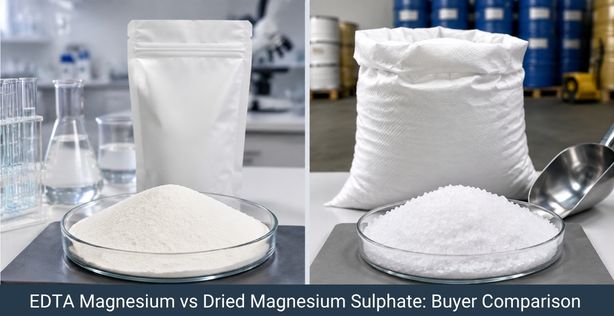
Bulk importers sourcing magnesium inputs from India repeatedly face one decision: whether to buy chelated EDTA Magnesium or the far cheaper Dried Magnesium Sulphate. The two deliver the same nutrient element yet behave as entirely different chemistries, price tiers, and performance classes. This comparison sets them side by side so global buyers, blenders, and formulators can match the right magnesium source to their crop, water, and process conditions.
Two Compounds, Two Chemistries: Defining the Magnesium Sources
EDTA Magnesium is the magnesium disodium salt of Ethylenediaminetetraacetic Acid, commonly written as Mg EDTA or magnesium disodium EDTA and catalogued under the CAS family of edetate chelates. Here the metal ion sits locked inside a hexadentate organic cage, a claw like structure that gives chelation its name from the Greek word chele. Dried Magnesium Sulphate, by contrast, is a simple inorganic salt with the formula MgSO4 in a partially dehydrated state, produced by driving off water from the familiar heptahydrate. It carries many regional and traditional names that importers encounter across markets:
| Name | Region or context |
| Epsom salt | Common trade name for the heptahydrate |
| Bitter salt | Traditional English and colonial trade name |
| Bittersalz | German language markets |
| Sulfate de magnesium | French language markets |
| Kieserite | Mineral monohydrate form MgSO4 and one water |
| Sal amargo | Spanish speaking markets |
Nutrient Payload and Chelated Content: What the Buyer Actually Pays For
The headline difference is elemental density versus protection. Dried Magnesium Sulphate carries a high magnesium load because it has no bulky organic ligand attached, while EDTA Magnesium carries less magnesium per kilogram because much of its mass is the protective chelating molecule. Buyers must read the specification for guaranteed magnesium content rather than assuming the two are interchangeable on a weight basis.
| Parameter | EDTA Magnesium | Dried Magnesium Sulphate |
| Typical magnesium content | Around 6 percent | Around 16 percent |
| Chemical class | Organic chelate | Inorganic sulphate salt |
| Anion or carrier | EDTA ligand | Sulphate, adds a sulphur nutrient |
| Physical form | Free flowing powder | Crystalline or dried powder |
| Water solubility | Fully water soluble | Readily water soluble |
Chelation Stability and Soil Behaviour: Why Protection Matters
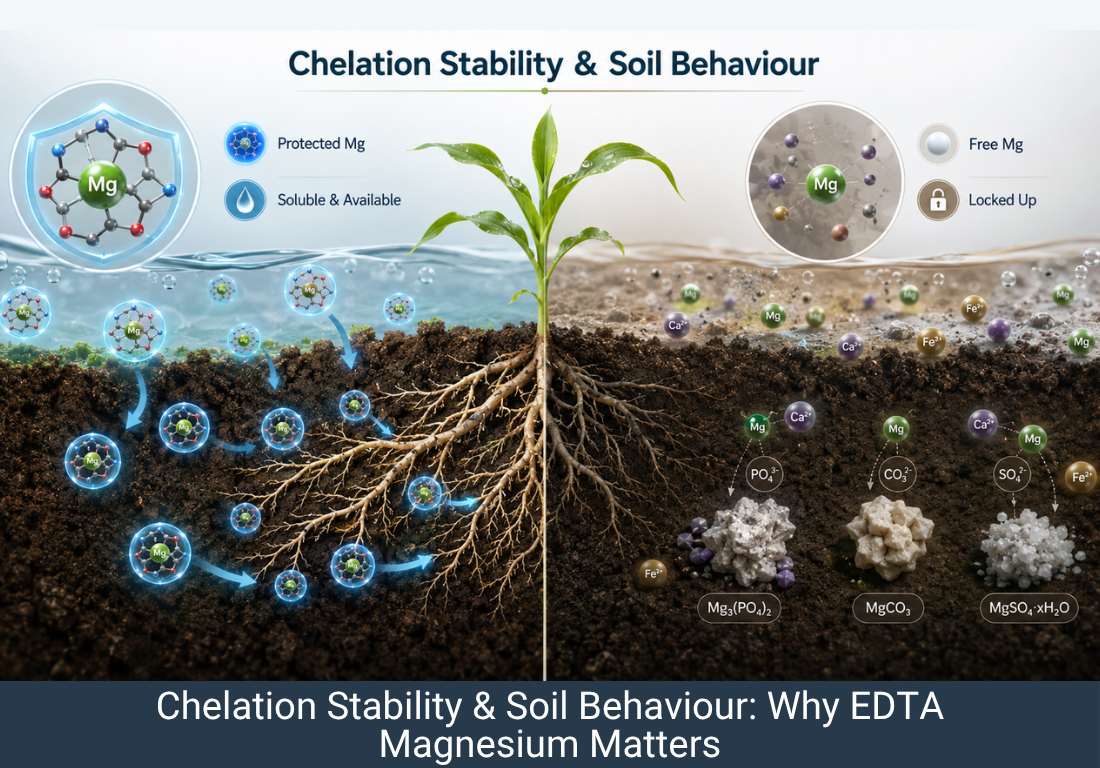
The value of EDTA Magnesium lies not in how much magnesium it holds but in how well it defends that magnesium against being locked up. In soil and tank solutions, free magnesium ions from a sulphate can react with phosphates, carbonates, and competing cations and precipitate into forms plants cannot absorb. The EDTA cage keeps the ion soluble and available. Chemists express this holding power as a stability constant, written as log K, and it explains why chelates command a premium. Magnesium forms a comparatively modest bond with EDTA, which is a nuance sophisticated buyers should understand rather than assume every chelate is equally strong.
Our Other Product
Zinc Sulfate Monohydrate 33% & 36%| Metal EDTA chelate | Approximate log K stability |
| Iron three EDTA | Around 25 |
| Copper EDTA | Around 18 |
| Zinc EDTA | Around 16 |
| Calcium EDTA | Around 11 |
| Magnesium EDTA | Around 9 |
Because magnesium sits low on this scale, EDTA Magnesium is best deployed where its solubility and compatibility advantages, rather than extreme bond strength, are the deciding factors.
Application Fit and Water Compatibility: Matching Product to Use Case
Dried Magnesium Sulphate suits open field correction of magnesium deficiency, soil application, and situations where sulphur is also wanted, and it performs well in soft, slightly acidic water. It struggles in hard water rich in calcium and bicarbonate, where it can cloud a spray tank and clog fine emitters. EDTA Magnesium is engineered for exactly those difficult settings: drip irrigation, fertigation lines, foliar sprays mixed with hard water, and premium liquid fertilizer blends where clarity and tank stability are non negotiable. Formulators building water soluble NPK blends, hydroponic nutrient solutions, and specialty foliar products choose the EDTA chelate to guarantee a clear, residue free solution that will not damage equipment.
Our Other Product
Copper SulphateCost, Grade, and Sourcing Strategy for Global Importers
Price separates these products by an order of magnitude, so smart procurement is about placing each where it earns its cost rather than defaulting to the cheapest. A practical sourcing framework helps bulk buyers and global agencies decide:
- Choose Dried Magnesium Sulphate for high volume, cost sensitive soil correction, and where a sulphur contribution adds value to the crop programme.
- Choose EDTA Magnesium for hard water regions, precision fertigation, hydroponics, and branded liquid formulations where solubility and stability protect the end product.
- Blend both when a fertilizer line needs an economical magnesium base plus a chelated fraction for guaranteed availability.
- Confirm the grade, since EDTA Magnesium is supplied in agricultural and technical grades while magnesium sulphate is sold in fertilizer, technical, and refined tiers.
As an established EDTA Magnesium manufacturer and Dried Magnesium Sulphate supplier serving importers across Europe, the Gulf, Southeast Asia, Africa, and Latin America, Shivam Agro Industries positions both products so that international buyers can consolidate a complete magnesium portfolio from a single Indian source, backed by consistent specifications, batch documentation, and export ready packaging.