


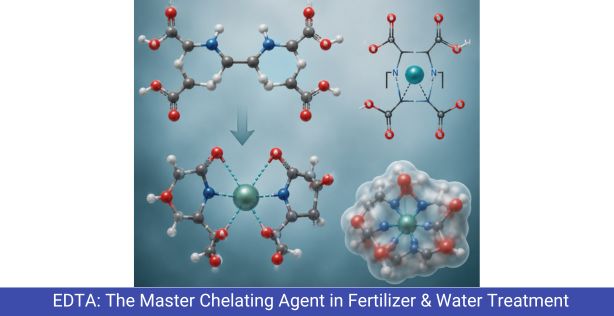
Understanding EDTA: The Master Chelating Agent
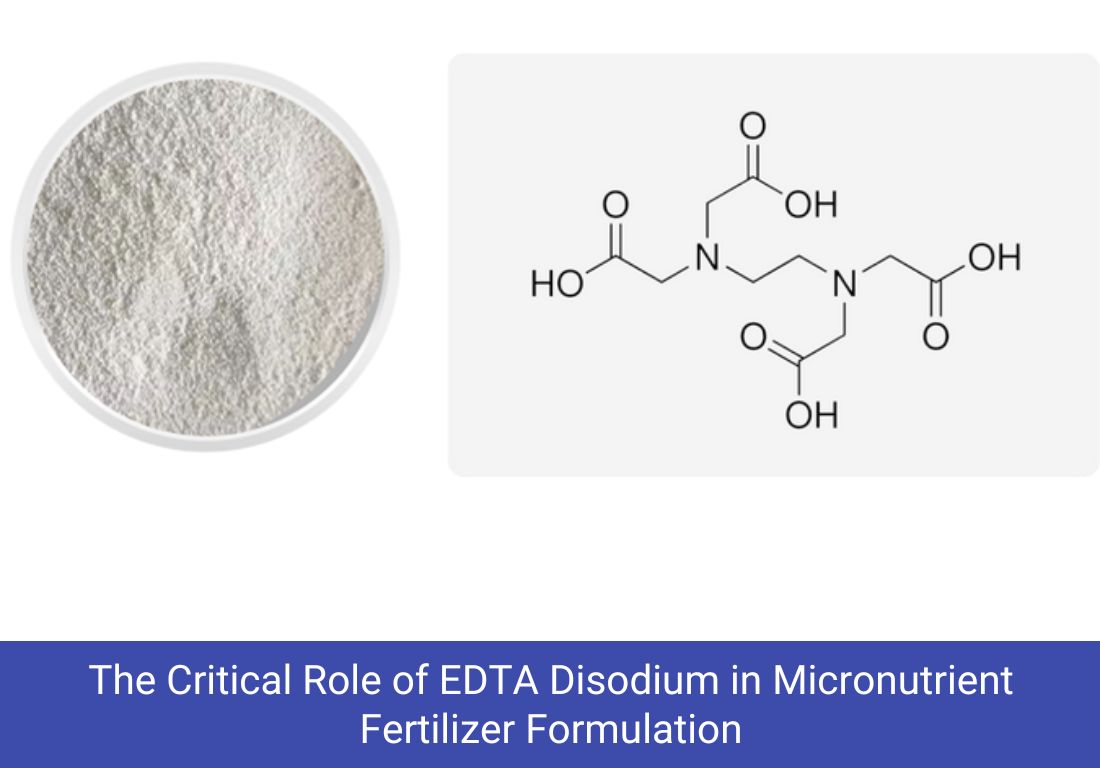
Ethylenediaminetetraacetic Acid (EDTA) is a synthetic aminopolycarboxylic acid with the molecular formula C₁₀H₁₆N₂O₈ and a molecular weight of 292.24 g/mol. Its remarkable chelating power arises from its molecular architecture: four carboxylate (-COOH) groups and two amine (-NH) nitrogen atoms arranged symmetrically around a short ethylene backbone. These six donor groups can simultaneously coordinate to a single metal ion, forming a hexadentate chelate complex—an exceptionally stable, cage-like structure that effectively removes the metal ion from solution and prevents it from participating in unwanted reactions.
EDTA in its free acid form (the protonated form) has very low water solubility—typically less than 0.5 g per 100 mL of water at room temperature. To produce a practically useful, highly water-soluble chelating agent, EDTA acid is neutralised with sodium hydroxide to form either EDTA Disodium (partial neutralisation, two sodium atoms replacing two acidic protons) or EDTA Tetrasodium (complete neutralisation, four sodium atoms replacing all four acidic protons).
EDTA Disodium (Na₂EDTA): Chemistry, Properties & Manufacturing
Chemical Profile
EDTA Disodium (disodium ethylenediaminetetraacetate dihydrate; CAS 6381-92-6) is produced by reacting EDTA Acid with two equivalents of sodium hydroxide in water, followed by crystallisation or spray drying. Key properties:
- Molecular formula: C₁₀H₁₄N₂Na₂O₈ · 2H₂O
- Molecular weight: 372.24 g/mol (dihydrate)
- Appearance: White, free-flowing crystalline powder
- Solubility: Approximately 100 g/L in water at 20°C
- Solution pH: 4.0–5.5 (typical 1% aqueous solution)
- Chelation value: Approximately 106–108 mg CaCO₃/g (as dry weight)
Manufacturing Process at Shivam Agro Industries
Shivam Agro Industries manufactures EDTA Disodium through a controlled batch or continuous neutralisation process:
- EDTA Acid is slurried in purified water in a temperature-controlled reactor.
- Sodium hydroxide solution (typically 30–50% NaOH) is added in a precisely controlled stoichiometric ratio of two moles NaOH per mole EDTA Acid, while maintaining reaction temperature between 50°C and 70°C.
- The reaction mixture is monitored for pH (target 4.3–5.0 for the disodium form) and reaction completeness.
- The resulting EDTA Disodium solution is clarified by filtration to remove any undissolved particles or impurities.
- The clear EDTA Disodium solution is dried by spray drying (to produce free-flowing powder) or by vacuum crystallisation (to produce crystalline dihydrate).
- The dried product is milled, screened to particle size specification, tested against quality standards, and packaged for dispatch.
Shivam Agro Industries produces EDTA Disodium in technical grade (for industrial applications), food grade (E386 for food applications), and agricultural grade (for chelated fertilizer manufacturing), allowing customers across different sectors to source the appropriate quality from a single trusted supplier.
Read Our Article
Manufacturer of EDTA Chemicals & Chelated MicronutrientsEDTA Tetrasodium (Na₄EDTA): Chemistry, Properties & Manufacturing
Chemical Profile
EDTA Tetrasodium (tetrasodium ethylenediaminetetraacetate; CAS 64-02-8) is produced by complete neutralisation of all four carboxylic acid groups of EDTA with four equivalents of sodium hydroxide. Key properties:
- Molecular formula: C₁₀H₁₂N₂Na₄O₈
- Molecular weight: 380.17 g/mol
- Appearance: White crystalline powder
- Solubility: >400 g/L in water at 20°C (highly water soluble)
- Solution pH: 10.5–11.5 (strongly alkaline in typical 1% solution)
- Chelation value: Approximately 100–106 mg CaCO₃/g
Key Differences: EDTA Disodium vs. EDTA Tetrasodium - A Technical Comparison
- Sodium content: Na₂EDTA has 2 sodium atoms; Na₄EDTA has 4 sodium atoms, giving Na₄EDTA approximately 24% sodium by weight vs. approximately 12% for Na₂EDTA.
- Solubility: Na₄EDTA is approximately 4 times more soluble than Na₂EDTA, making it the preferred form where very high-concentration chelating solutions are needed.
- Solution pH: Na₂EDTA solutions are mildly acidic to neutral (pH 4–5.5); Na₄EDTA solutions are strongly alkaline (pH 10.5–11.5).
- Agricultural use: Na₂EDTA is preferred for chelated fertilizer production because its mildly acidic pH is compatible with agricultural micronutrient salt reactions. Na₄EDTA is less commonly used in direct agricultural formulation but serves important industrial roles.
- Industrial preference: Na₄EDTA’s high solubility and alkaline pH make it ideal for alkaline industrial processes including detergent manufacture, textile processing, and alkaline cleaning formulations.
Our Other Product
Manganese Bisglycinate (Manganese Glycinate)The Critical Role of EDTA Disodium in Fertilizer Formulation
Every chelated micronutrient fertilizer-EDTA Zinc, EDTA Calcium, EDTA Magnesium, EDTA Copper, EDTA Manganese, EDTA Ferric-is manufactured using EDTA Disodium as the primary chelating agent. Understanding this manufacturing process illuminates why EDTA Disodium is such a strategically important industrial chemical for the agricultural sector:
How EDTA Chelated Micronutrients Are Made
The basic reaction for producing any EDTA chelated micronutrient is:
Na₂EDTA + MeSO₄ (or MeCl₂) → Me-EDTA + Na₂SO₄ (or 2NaCl)
Where Me = metal ion (Zn²⁺, Ca²⁺, Mg²⁺, Cu²⁺, Mn²⁺) or Fe³⁺ for ferric chelate.
In practice, Shivam Agro Industries conducts this reaction in a controlled environment:
- Dissolve EDTA Disodium in water to produce a chelating solution of the required concentration.
- Dissolve the metal salt (e.g., zinc sulphate, copper sulphate, calcium chloride) in water to produce a metal ion solution.
- Combine the two solutions in the stoichiometric ratio (1 mole Na₂EDTA per mole metal ion) with careful pH control.
- Monitor chelate formation by measuring the free metal ion concentration-when chelation is complete, essentially no free metal ions remain in solution.
- Adjust pH to the target range for the specific chelate (typically pH 7–9 for most agricultural EDTA chelates).
- Dry the chelate solution by spray drying to produce a free-flowing powder with the specified metal content (e.g., 12% Zn, 10% Ca, 6% Mg, 15% Cu, 12% Mn, 12% Fe).
The quality of the EDTA Disodium raw material-its purity, chelation capacity, and consistency-is the primary determinant of the quality of the chelated micronutrient product. Shivam Agro Industries’ commitment to high-quality EDTA Disodium manufacturing is the foundation of its chelated micronutrient product quality.
EDTA in Water Treatment: Mechanisms and Applications
Beyond agriculture, EDTA Disodium and EDTA Tetrasodium perform critical functions in industrial and municipal water treatment:
Scale Inhibition in Boilers and Cooling Systems
When hard water containing dissolved calcium (Ca²⁺) and magnesium (Mg²⁺) ions is heated or evaporated, calcium carbonate (CaCO₃) and magnesium carbonate (MgCO₃) scale deposits form on heat transfer surfaces. These scale deposits reduce heat transfer efficiency (even 1 mm of scale reduces heat transfer by approximately 7–10%), increase energy consumption, and can lead to boiler tube overheating and failure.
EDTA Disodium added to boiler feedwater or cooling water chelates calcium and magnesium ions, keeping them in stable, soluble chelate form and preventing scale formation. EDTA also chelates iron, copper, and manganese ions that would otherwise catalyse corrosion reactions in the water system.
Metal Ion Sequestration in Process Water
In pulp and paper manufacturing, textile dyeing, and chemical processing, dissolved heavy metal ions in process water interfere with bleaching agents (oxidative decomposition), dye uptake (colour inconsistency), and catalyst systems (unwanted side reactions). EDTA Tetrasodium-preferred for its high solubility and alkalinity compatibility with these processes-sequesters interfering metal ions and improves process quality and consistency.
Soil Remediation and Metal Extraction
EDTA chelates heavy metals (lead, cadmium, copper, zinc) in contaminated soils and can be used in soil washing operations to mobilise and extract these metals for remediation. This application of EDTA is used in environmental cleanup of industrial contaminated sites.
EDTA in Detergents and Cleaning Formulations
The detergent and cleaning products industry is one of the largest consumers of EDTA Disodium and EDTA Tetrasodium globally. EDTA serves as a chelating builder in both household and industrial cleaning products:
- In laundry detergents: EDTA chelates calcium and magnesium hardness ions in wash water, preventing them from reacting with anionic surfactants (which would form insoluble soaps that reduce cleaning efficiency) and from interfering with bleaching agents (particularly oxygen bleaches like sodium percarbonate and perborate).
- In dishwashing detergents: EDTA prevents precipitation of calcium and magnesium salts from hard water that would otherwise leave white scale deposits on dishes and glassware.
- In industrial hard-surface cleaners: EDTA chelates scale deposits (calcium carbonate) and metal oxide films, helping cleaners dissolve and remove mineral scale from industrial equipment surfaces.
- In pulp and paper bleaching: EDTA chelates manganese ions that would decompose hydrogen peroxide bleach prematurely, improving bleaching efficiency and reducing chemical consumption.
Our Other Product
Copper Bisglycinate (Copper Glycinate)EDTA in Food Preservation (E385/E386)
EDTA Disodium (as calcium disodium EDTA, E385, or disodium EDTA, E386) is approved as a food additive in many countries for use as a preservative sequestrant in processed and canned foods. In food applications, EDTA:
- Chelates trace metal ions (copper, iron) that catalyse lipid oxidation and rancidity-preserving flavour, colour, and shelf life in canned fish, canned vegetables, salad dressings, and mayonnaise.
- Prevents struvite (magnesium ammonium phosphate) crystal formation in canned seafood.
- Maintains the bright colour of green vegetables in canned products by stabilising chlorophyll against magnesium displacement.
Shivam Agro Industries produces food-grade EDTA Disodium complying with Food Chemicals Codex (FCC) and IS specifications for customers in the food and beverage manufacturing industry.
Buying EDTA Disodium and EDTA Tetrasodium from Shivam Agro Industries
Shivam Agro Industries is a wholesale EDTA Disodium manufacturer and EDTA Tetrasodium supplier in India serving customers across the fertilizer, food, detergent, water treatment, textile, and pharmaceutical industries. The company offers:
- Multiple grades: Technical grade, food grade, and agricultural grade EDTA salts to meet the specific purity requirements of each industry.
- Flexible packaging: Standard 25 kg multi-layer kraft paper bags, HDPE drums, and jumbo bags for bulk supply.
- Custom specifications: EDTA Disodium in powder or granular forms; EDTA Tetrasodium in powder form; concentration and purity customised to customer formulation requirements.
- Full documentation: Certificate of Analysis (COA), Material Safety Data Sheet (MSDS), technical data sheets, and all export documentation for international customers.
- Export capability: Established EDTA Disodium exporter with experience supplying Asian, Middle Eastern, African, and other international markets.