


Calcium: The Structural Architect of Plant Health
Of all the essential nutrients, calcium occupies a unique position in plant biology. Unlike nitrogen, phosphorus, or potassium-which are highly mobile within plants and can be redistributed from older to younger tissues when supplies are limited-calcium is essentially immobile once it has been deposited in cell walls and membranes. This immobility has profound consequences for crop management:
- It means that a continuous external supply of calcium to growing tissues is essential at all times during the growing season.
- It means that calcium deficiency symptoms always appear first in the youngest, fastest-growing parts of the plant-young leaves, shoot tips, and developing fruit-even when older leaves contain adequate calcium.
- It means that whole-plant calcium status as measured in leaf analyses can be misleading: a plant may test as ‘calcium adequate’ overall while suffering severe calcium deficiency disorders in specific organs.
Understanding these unique characteristics of calcium nutrition is the key to understanding why EDTA Calcium (chelated calcium) used as a foliar spray is such a powerful tool for crop quality management.
Calcium's Essential Functions in Plants
Cell Wall Structure and Strength
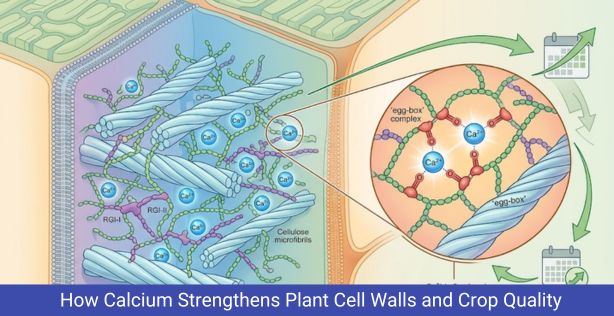
Calcium is the primary cross-linking element in the middle lamella-the pectin-rich layer that binds adjacent plant cells together. Calcium ions (Ca²⁺) form ionic bridges between the carboxyl groups of pectic acid chains in the cell wall, creating a rigid, stable structure that:
- Provides mechanical strength and prevents cell collapse
- Maintains turgor and cell shape under water stress
- Creates physical barriers that resist pathogen penetration and mechanical damage
- Slows cell wall degradation during fruit ripening, extending post-harvest shelf life
When calcium is deficient in rapidly growing tissues, newly formed cell walls are structurally weak-lacking adequate calcium cross-linking. These weak walls collapse, causing the characteristic brown or black breakdown of tissue that defines most calcium deficiency disorders.
Read Our Article
How EDTA Disodium Improves Fertilizer Stability in AgricultureCell Membrane Integrity
Calcium is essential for maintaining the selective permeability and structural integrity of cell membranes (plasma membrane and tonoplast). Adequate calcium at the membrane surface prevents leakage of cellular contents, maintains ion gradients, and enables normal cell signalling. Calcium-deficient cells leak electrolytes and metabolites, leading to rapid tissue collapse-the basis of tipburn, bitter pit, and similar disorders.
Signal Transduction
Free calcium ions (Ca²⁺) in the cytoplasm function as a universal second messenger in plant cells, transmitting signals from receptors on the cell surface to metabolic pathways in the cytoplasm and nucleus. Calcium signals regulate responses to environmental stresses (drought, pathogen attack, mechanical stimulation), plant hormone responses, and developmental transitions. Adequate calcium nutrition supports robust stress signalling and defence responses.
Enzyme Activation
Calcium activates several key plant enzymes including alpha-amylase, cell-wall-modifying enzymes, and calcium-dependent protein kinases (CDPKs) that regulate numerous metabolic processes. Calcium deficiency disrupts these enzyme systems, reducing metabolic efficiency and crop performance.
Our Other Product
EDTA Copper (Ethylenediaminetetraacetic Acid Copper)The Paradox of Calcium Delivery in Plants
Despite calcium’s critical importance, delivering it to where it is needed in the plant is uniquely challenging. Calcium moves through plants almost exclusively via the xylem-the water-conducting tissue-driven by transpiration (water evaporation from leaves). This means:
- Well-ventilated, actively transpiring leaves receive ample calcium from xylem flow.
- Fruit, which transpires very little compared to leaves, receives far less calcium from the xylem stream, even when soil calcium supply is adequate.
- Young, rapidly expanding shoot tips and new leaves-which have high metabolic calcium demand but limited transpiration-are chronically undersupplied with calcium from xylem transport.
- Night-forming tissues in glasshouses or during calm, humid conditions-when transpiration essentially stops-may receive virtually no calcium via xylem flow.
This is why calcium deficiency disorders occur even in soils with ample calcium, and why increasing soil calcium supply often fails to correct disorders in fruit and young tissues. The solution is to deliver calcium directly to deficient tissues via foliar spray-and this is where EDTA Calcium excels.
What is EDTA Calcium and Why is it Superior to Other Calcium Fertilizers?
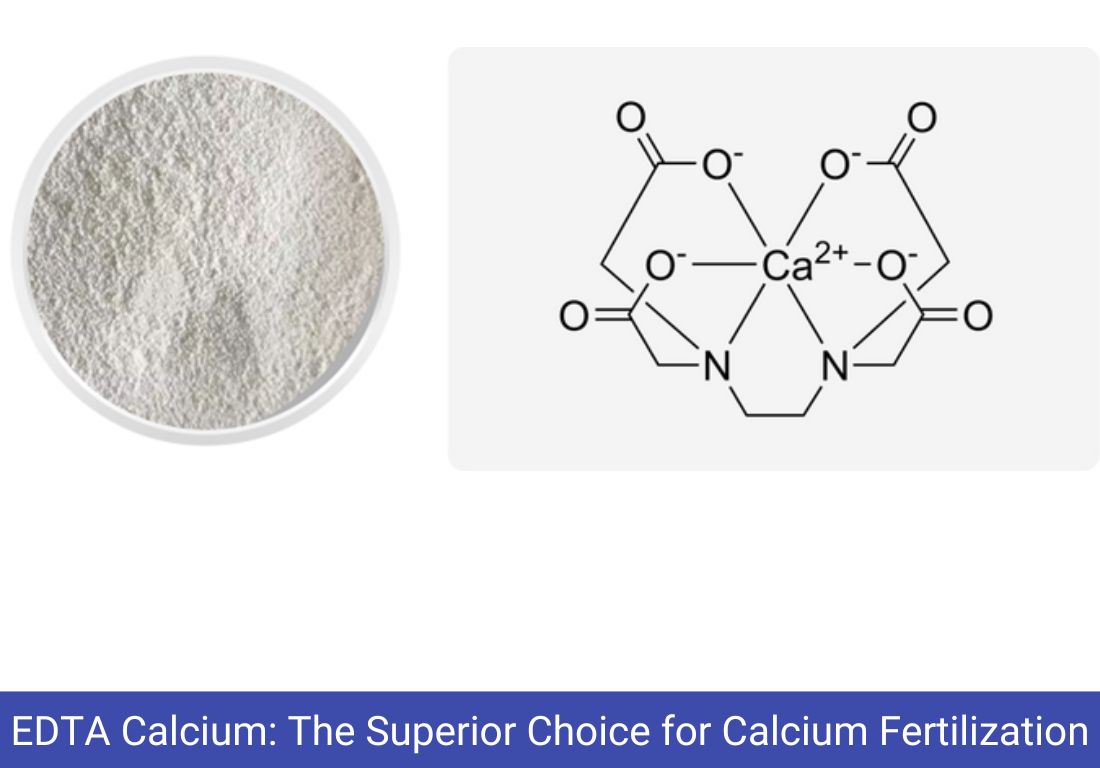
EDTA Calcium (Ca-EDTA) is produced by reacting calcium chloride or calcium oxide with EDTA Acid under controlled conditions to form a stable, water-soluble calcium chelate complex. Shivam Agro Industries produces EDTA Calcium containing 10% water-soluble calcium as the standard agricultural grade.
Read Our Article
How EDTA Zinc Fertilizer Solves Zinc Deficiency in CropsAdvantages of EDTA Calcium over Calcium Chloride, Calcium Nitrate, and Calcium Sulphate
- Superior foliar absorption: The EDTA chelate facilitates penetration of calcium through the waxy cuticle of leaf and fruit surfaces far more efficiently than inorganic calcium salts. This makes EDTA Calcium the most effective form for foliar delivery to fruit and young tissues.
- No phytotoxicity: Calcium chloride applied as a foliar spray can cause leaf burn (edge scorch) at concentrations needed for effective calcium delivery. EDTA Calcium can be applied at effective rates without phytotoxicity risk.
- 100% water solubility: Unlike calcium sulphate (gypsum), which has very low water solubility, EDTA Calcium dissolves completely for foliar or fertigation application.
- Stability in solution: EDTA Calcium remains stable in tank mixes over time and does not precipitate when mixed with potassium or magnesium fertilizers in the spray tank.
- Compatibility: EDTA Calcium is compatible with most foliar spray programs and does not interfere with pesticide efficacy when used in tank mixes (verify with small-scale compatibility tests).
Calcium Glycine Amino Acid Chelate (Calcium Bis Glycinate) is a premium alternative produced by Shivam Agro Industries using glycine amino acid as the chelating ligand. It provides calcium alongside the amino acid glycine and is absorbed via plant amino acid transporters, offering potentially superior uptake in some crops.
Calcium Deficiency Disorders: What EDTA Calcium Prevents and Corrects
Blossom End Rot in Tomato, Pepper, and Watermelon
Blossom end rot (BER) is the most economically damaging calcium deficiency disorder in vegetable crops globally. It appears as dark, sunken, leathery lesions at the blossom end (bottom) of tomato, pepper, courgette, and watermelon fruit. BER occurs when calcium supply to the developing fruit is insufficient during the rapid fruit cell division phase shortly after pollination. Calcium demand at this stage is high, but transpiration-driven xylem flow to fruit is low-creating a localised calcium deficiency even when the plant appears healthy overall.
Regular foliar applications of EDTA Calcium 10% beginning at first flowering and continuing at 10–14 day intervals throughout fruit development prevent BER effectively. Shivam Agro Industries recommends 1.5–2.0 g of EDTA Calcium per litre of water applied as a fine mist spray directly onto developing fruit clusters and young leaves.
Bitter Pit in Apple
Bitter pit is a post-harvest calcium deficiency disorder of apple fruit characterised by small, brown, corky spots just beneath the skin surface, which cause bitter flavour and unmarketable fruit appearance. Bitter pit incidence is directly related to the fruit calcium content at harvest. In high-yielding seasons with large fruit, calcium concentration in individual fruit is diluted below the threshold needed to maintain cell membrane integrity.
A seasonal program of EDTA Calcium foliar sprays-typically 4–6 applications from 2 weeks after full bloom through to 6 weeks before harvest-consistently reduces bitter pit incidence and improves apple skin finish and storage quality.
Our Other Product
EDTA Magnesium (Ethylenediaminetetraacetic Acid Magnesium)Tip Burn in Lettuce, Cabbage, and Leafy Vegetables
Tip burn is a calcium deficiency disorder of inner leaves in lettuce, cabbage, Chinese cabbage, and similar leafy vegetables. The inner leaves-which are physically enclosed by outer leaves and thus have very low transpiration-receive minimal calcium from xylem flow. Tip burn causes brown, necrotic leaf margins that make the crop unmarketable.
Foliar applications of EDTA Calcium through the outer canopy into the heart of the plant, or through drip fertigation with high-frequency, low-volume irrigation cycles that maintain consistent calcium supply, are the most effective management strategies.
Blackheart in Celery and Internal Browning in Brassicas
Similar calcium-deprivation disorders occur in the innermost, lowest-transpiration organs of celery (blackheart of the inner stalks), broccoli (hollow stem), and other Brassica vegetables. EDTA Calcium applied as a foliar spray or through low-volume, high-frequency irrigation provides the steady calcium supply these tissues require.
Flower and Shoot Tip Die-Back
In many ornamental and fruit crops, calcium deficiency causes die-back of young shoot tips and flower buds-symptoms sometimes confused with fungal disease or frost damage. EDTA Calcium foliar programs during periods of rapid shoot growth prevent this disorder.
How to Apply EDTA Calcium for Maximum Crop Benefit
- Begin applications early: Start EDTA Calcium spray programs at flowering stage for fruit crops and at transplanting or early vegetative stage for vegetables-before deficiency symptoms appear.
- Apply every 10–14 days: Calcium is not redistributed within the plant, so regular, frequent applications are more effective than infrequent high-rate applications.
- Target the fruit and growing points: Direct the foliar spray to cover developing fruit clusters, shoot tips, and young leaves-the calcium-demanding tissues that transpiration cannot supply adequately.
- Apply in the morning or evening: Spray when temperatures are moderate and humidity is higher to maximise foliar absorption and minimise spray evaporation.
- Use recommended rates: 1.5–2.0 g of EDTA Calcium 10% per litre of water for foliar spray. 2–3 kg per hectare per application for fertigation through drip systems.