


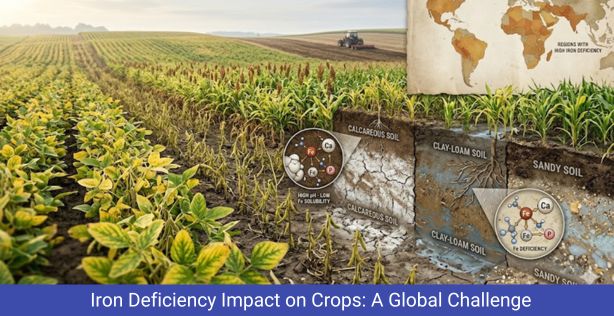
Why Iron Deficiency is a Major Agricultural Challenge
Iron (Fe) is the fourth most abundant element in the earth’s crust, yet iron deficiency-known as iron chlorosis-is one of the most common and economically significant micronutrient disorders in global agriculture. The paradox of iron deficiency in iron-rich soils is explained by chemistry: while total iron in soil is abundant, the plant-available fraction (Fe²⁺ and Fe³⁺ in solution) is governed by soil pH. In alkaline and calcareous soils-which account for more than 30% of the world’s agricultural land, including large areas of India, Pakistan, the Middle East, Mediterranean Europe, and Latin America-iron solubility drops to levels far below plant requirements.
At soil pH 7.0, Fe³⁺ solubility is already 1,000 times lower than at pH 6.0. At pH 8.0, it is 1,000,000 times lower. Even a small upward shift in soil pH can push crops into severe iron deficiency, manifesting as the characteristic interveinal chlorosis-yellowing of young leaves while the veins remain green-that growers in alkaline soil regions know all too well.
The crops most sensitive to iron chlorosis include grapes, citrus, peach, plum, apple, pear, blueberry, strawberry, soybean, peanut, chickpea, rice (in aerobic and upland conditions), and many vegetables grown in high-pH soils or hydroponic systems.
The Two Main Chelated Iron Options: EDTA Ferric and EDDHA Iron
To correct iron deficiency in alkaline soils, agronomists rely on chelated iron fertilizers that protect the iron from soil precipitation. Two families of iron chelate dominate the global market:
- EDTA Ferric (Fe-EDTA): Iron chelated with Ethylenediaminetetraacetic Acid. Contains 12% iron. The most widely used and cost-effective chelated iron fertilizer globally.
- EDDHA Iron (Fe-EDDHA): Iron chelated with Ethylenediamine-N,N’-bis(2-hydroxyphenylacetic acid). Contains 6% total iron, typically specified as ortho-ortho (o,o) isomer content. A premium-grade chelate with superior stability in calcareous soils.
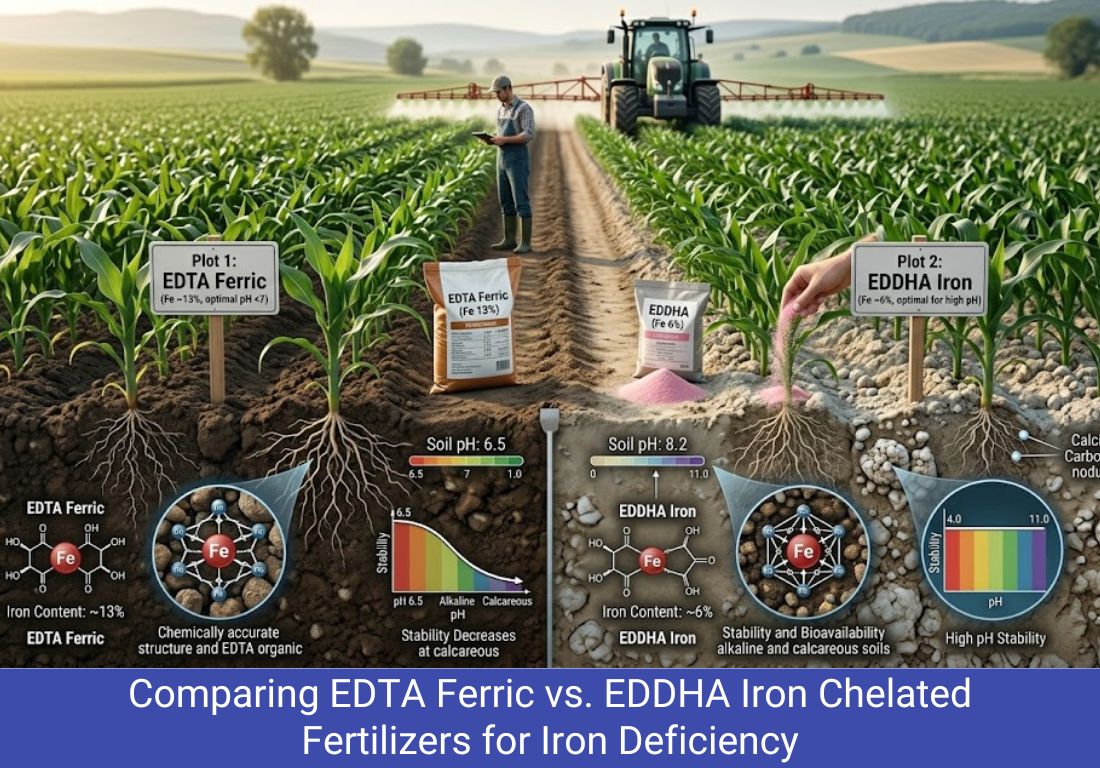
The key difference between EDTA Ferric and EDDHA Iron lies in the stability of the chelate complex at different soil pH values-a factor that has profound practical implications for which product is appropriate for a given agricultural situation.
Read Our Article
Manufacturer of EDTA Chemicals & Chelated MicronutrientsEDTA Ferric (Fe-EDTA 12%): Profile, Properties & Applications
Chemistry and Stability
EDTA Ferric is produced by reacting ferric chloride (FeCl₃) or ferric sulphate with Na₂EDTA (disodium EDTA) in a controlled reaction. The resulting bright-brown to yellow powder is 100% water soluble and contains 12% chelated iron (Fe³⁺). The EDTA chelate is thermodynamically stable, but its stability decreases with increasing pH. EDTA Ferric maintains effective iron chelation up to approximately soil pH 7.5. Above pH 7.5, calcium, magnesium, and bicarbonate ions in the soil solution begin to compete with iron for the EDTA ligand, releasing iron from the chelate and allowing it to precipitate as iron hydroxide or iron carbonate.
Best Applications for EDTA Ferric
- Foliar spray for iron chlorosis correction: EDTA Ferric 12% is the gold standard for foliar iron application because it provides a high iron concentration (12%) in a fully water-soluble, non-phytotoxic form that penetrates leaf surfaces efficiently. Foliar spray bypasses the soil pH limitation entirely-the chelate is applied directly to the plant.
- Drip fertigation in neutral to mildly alkaline soils (pH up to 7.5): EDTA Ferric delivered through drip irrigation in soils up to pH 7.5 provides effective iron nutrition. The iron is delivered directly to the root zone in solution, minimising contact with the bulk soil and reducing the time available for soil reactions.
- Hydroponic systems: EDTA Ferric is the standard iron source in most hydroponic nutrient solution formulations. At the controlled pH of 5.5–6.5 used in hydroponics, EDTA Ferric is completely stable and provides reliable iron nutrition.
- Greenhouse and protected cultivation: At the controlled pH levels typically maintained in greenhouse drip irrigation systems, EDTA Ferric performs excellently and provides cost-effective iron nutrition.
- Cost-sensitive applications where foliar correction is acceptable: EDTA Ferric 12% costs significantly less per kilogram than EDDHA Iron 6%, making it the economic choice where foliar application is agronomically appropriate.
Our Other Product
Dried Ferrous Sulphate (Ferrous Sulphate)EDDHA Iron (Fe-EDDHA 6%): Profile, Properties & Applications
Chemistry and Stability
EDDHA Iron is a structurally more complex chelate produced by reacting iron with EDDHA-a chelating ligand that incorporates two aromatic hydroxyl (phenolic) groups in addition to the nitrogen and carboxylate groups present in EDTA. These phenolic groups create a chelate with dramatically higher stability at elevated pH values. The ortho-ortho (o,o) isomer of Fe-EDDHA is the most stable form, retaining iron chelation in soil solution at pH values up to 11—far above the pH range encountered in any agricultural soil. The product specification for Fe-EDDHA typically states the percentage of ortho-ortho (o,o) chelated iron, with higher o,o content indicating superior agronomic performance.
Fe-EDDHA produces a characteristic deep red-brown powder or granule. Products are specified by total iron content (typically 6%) and the percentage of iron in the ortho-ortho chelated fraction (commonly 3.6–4.8% o,o Fe in commercial products).
Best Applications for EDDHA Iron
- Soil application in strongly calcareous and alkaline soils (pH 7.5–9.0): Fe-EDDHA is the only chelated iron fertilizer that provides reliable soil correction of iron deficiency in calcareous soils with pH above 7.5. Applied to soil-as a pre-plant incorporation, surface drench, or through drip irrigation-Fe-EDDHA remains stable against calcium and bicarbonate competition and delivers iron to plant roots effectively.
- Fruit and vine crops with severe iron chlorosis: Grapes, citrus, peach, plum, cherry, kiwi, apple, and other high-value fruit crops on alkaline soils consistently respond best to Fe-EDDHA soil application, which provides season-long iron nutrition from a single or split-application programme.
- Soybean and legumes in calcareous soils: Iron deficiency chlorosis (IDC) in soybean on calcareous soils is most effectively managed with Fe-EDDHA soil treatment. EDTA Ferric applied to soil is largely ineffective at pH > 7.5 due to rapid displacement by calcium.
- Correction in high-bicarbonate irrigation water conditions: High bicarbonate in irrigation water rapidly raises the pH of the rhizosphere, deactivating EDTA Ferric but not Fe-EDDHA. In regions with high-bicarbonate well water, Fe-EDDHA is the reliable soil treatment option.
Read Our Article
How EDTA Zinc Fertilizer Solves Zinc Deficiency in CropsHead-to-Head Comparison: EDTA Ferric vs. EDDHA Iron
Iron Content
EDTA Ferric: 12% Fe. EDDHA Iron: 6% total Fe (typically 3.6–4.8% as ortho-ortho fraction).
Chelate Stability in Soil
EDTA Ferric: Stable up to pH 7.5. EDDHA Iron: Stable up to pH 11 (ortho-ortho fraction).
Effective Soil pH Range
EDTA Ferric: Neutral to mildly alkaline (pH 4.0–7.5). EDDHA Iron: Neutral to strongly calcareous alkaline (pH 4.0–9.0+).
Best Application Route
EDTA Ferric: Foliar spray, fertigation, hydroponics. EDDHA Iron: Soil application, drip fertigation in alkaline soils.
Cost
EDTA Ferric: Lower cost per kg. EDDHA Iron: Higher cost per kg, but often lower application rate per hectare provides comparable economics for soil correction.
Colour
EDTA Ferric: Yellow to light brown powder. EDDHA Iron: Deep red-brown powder.
Our Other Product
Zinc Bisglycinate (Zinc Glycinate)Practical Decision Guide: Which Iron Chelate Should You Choose?
Choose EDTA Ferric (Fe-EDTA 12%) when:
- Soil pH is below 7.5 and foliar spray or fertigation is the primary application route
- Iron deficiency is mild to moderate and foliar correction will resolve it promptly
- The crop is grown in a hydroponic or greenhouse system with controlled pH
- Cost is a primary consideration and multiple foliar sprays are agronomically acceptable
Choose EDDHA Iron (Fe-EDDHA 6%) when:
- Soil pH is above 7.5, particularly in calcareous or bicarbonate-rich soils
- Soil application (pre-plant, drench, or drip) is the required correction route
- The crop is a high-value fruit, vine, or legume with severe, season-limiting iron chlorosis
- Irrigation water has high bicarbonate alkalinity (>3 meq/L) that pushes rhizosphere pH up
- A single soil application providing season-long iron nutrition is preferred over repeated foliar sprays
Shivam Agro Industries: Your Trusted EDTA Ferric Manufacturer & Supplier
Shivam Agro Industries is a leading manufacturer, supplier, and exporter of EDTA Ferric (Fe-EDTA 12%) and Fe EDDHA from India. The company supplies chelated iron fertilizers to domestic fertilizer manufacturers, agrochemical companies, and wholesale buyers, as well as to international export markets across Asia, the Middle East, and Africa. All products are manufactured as 100% water-soluble powders with full quality documentation including Certificate of Analysis (COA), MSDS, and FCO compliance.