


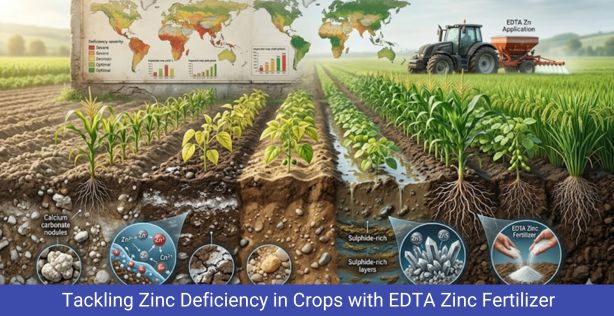
The Global Zinc Deficiency Crisis in Agriculture
Zinc is one of 17 essential nutrients required by all plants, and its deficiency is the most widespread micronutrient disorder in global agriculture. The International Zinc Association estimates that over 50% of agricultural soils worldwide are zinc deficient, and in India-a country with more than 140 million hectares of cultivated land-zinc deficiency has been documented in nearly 49% of soil samples tested across agricultural zones.
Zinc deficiency is particularly severe in:
- Calcareous and alkaline soils (pH above 7.0) where zinc forms insoluble compounds with calcium carbonate
- Highly leached sandy soils with low organic matter
- Waterlogged soils where zinc is immobilised by sulphide formation
- Intensively cropped soils where zinc removal by high-yielding crop varieties exceeds natural replenishment
- Soils with high phosphorus content, where phosphate-zinc antagonism reduces zinc availability
The consequence of uncorrected zinc deficiency is severe: yield losses of 20 to 50% in sensitive crops, reduced grain quality, poor seed development, increased susceptibility to disease, and low nutritional value in food crops consumed by zinc-deficient populations.
Recognising Zinc Deficiency: Visual Symptoms by Crop
Accurate identification of zinc deficiency is the first step to effective management. Classic visual symptoms include:
Cereal Crops (Rice, Wheat, Maize)
- Khaira disease in paddy rice: Brownish spots and interveinal chlorosis on younger leaves, followed by stunting and plant death in severe cases
- White bud in maize: Pale, bleached, striped young leaves. Severely affected plants remain stunted with shortened internodes
- Wheat: Chlorotic striping on younger leaves, tillering reduction, and poor spike fill
Fruit Crops (Mango, Citrus, Grapes, Apple)
- Little leaf or rosette: Shortened internodes producing tight clusters of small, narrow, pale leaves at shoot tips
- Mottle leaf: Irregular pale yellow mottling between green veins on mature leaves
- Poor fruit set and small, misshapen fruit
Vegetable Crops (Tomato, Potato, Onion)
- Yellowing and bronzing of young leaves between veins
- Reduced plant height and poor branching
- Delayed maturity and reduced marketable yield
Read Our Article
Manufacturer of EDTA Chemicals & Chelated MicronutrientsWhy Conventional Zinc Sulphate Often Fails
The traditional approach to correcting zinc deficiency is soil application of zinc sulphate (ZnSO₄ · 7H₂O, 21–22% Zn). While zinc sulphate is inexpensive and widely available, it has significant limitations that reduce its effectiveness in many Indian agricultural conditions:
- Soil fixation: In alkaline and calcareous soils (pH > 7.0), zinc from zinc sulphate rapidly precipitates as insoluble zinc carbonate (ZnCO₃) and zinc hydroxide (Zn(OH)₂), becoming unavailable to plants within days of application.
- Phosphate antagonism: High soil phosphate concentrations, common in intensively fertilised Indian soils, further immobilise zinc by forming insoluble zinc phosphate complexes.
- Low plant uptake efficiency: Only 2–5% of applied zinc sulphate is typically absorbed by the crop in its season of application. The remainder remains fixed in the soil, requiring repeated applications and increasing the risk of soil zinc accumulation.
- Incompatibility: Zinc sulphate cannot be mixed with phosphatic fertilizers or used in tank mixes with calcium-containing formulations without precipitation.
What is EDTA Zinc and How Does It Work?
EDTA Zinc (also written as Zn-EDTA or chelated zinc 12%) is produced by reacting zinc sulphate or zinc oxide with EDTA Acid (Ethylenediaminetetraacetic Acid) in a controlled chemical process. The EDTA molecule forms a cage-like, ring-shaped structure around the zinc ion, creating a stable, water-soluble complex-the chelate-that protects zinc from soil fixation, precipitation, and antagonism.
The EDTA Chelation Advantage
- pH stability: EDTA Zinc remains fully soluble and plant available across soil and solution pH values from 4.0 to 7.5-covering the majority of agricultural soils. Standard zinc sulphate begins precipitating above pH 6.5.
- Protection from soil reactions: The EDTA cage prevents zinc from reacting with carbonates, phosphates, hydroxides, and organic matter in the soil, keeping it in solution long enough for root absorption.
- Higher uptake efficiency: Studies consistently show that EDTA chelated zinc provides 3 to 5 times more efficient zinc delivery to crops compared to equivalent rates of zinc sulphate on alkaline soils.
- Foliar application compatibility: EDTA Zinc dissolves completely and can be applied as a foliar spray, delivering zinc directly through leaf surfaces for the fastest possible correction of acute deficiency-often showing visible results within 7 to 14 days.
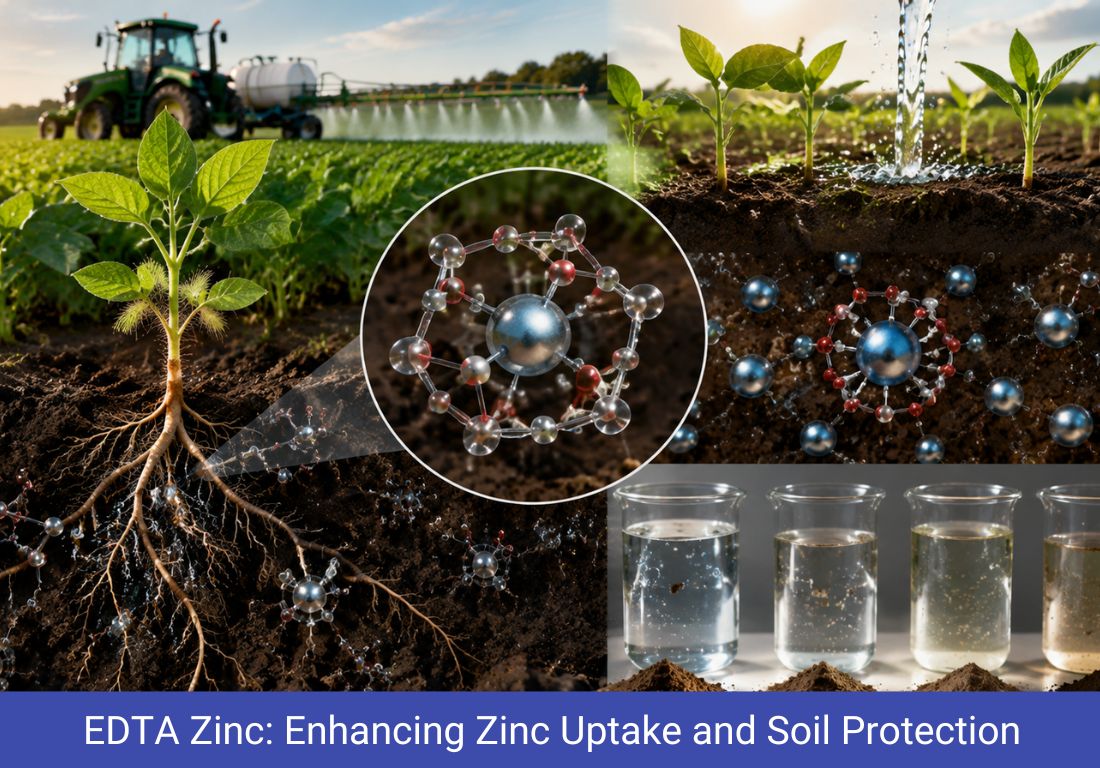
- Fertigation compatibility: 100% water soluble with no residue, EDTA Zinc is ideal for drip irrigation and fertigation systems where tank mix compatibility with NPK fertilizers is essential.
Our Other Product
Magnesium Bisglycinate (Magnesium Glycinate)EDTA Zinc vs. Zinc Sulphate: A Practical Comparison
Solubility
EDTA Zinc 12%: 100% water soluble, no sediment. Zinc sulphate 21%: Water soluble but precipitates rapidly in alkaline solutions.
pH Effectiveness Range
EDTA Zinc: Effective from pH 4.0 to 7.5. Zinc sulphate: Effective only below pH 6.5.
Application Methods
EDTA Zinc: Soil drench, drip fertigation, foliar spray. Zinc sulphate: Primarily soil broadcast application.
Tank Mix Compatibility
EDTA Zinc: Compatible with most water-soluble NPK fertilizers. Zinc sulphate: Incompatible with phosphatic and calcium-containing fertilizers.
Crop Response Speed
EDTA Zinc (foliar): Visible improvement within 7–14 days. Zinc sulphate (soil): Response may take 3–6 weeks in alkaline soils.
How to Apply EDTA Zinc Fertilizer
Foliar Spray Application
Foliar spray is the fastest and most efficient method for correcting acute zinc deficiency. Prepare a spray solution of 0.5–1.0 g of EDTA Zinc 12% per litre of water (0.05–0.10% solution). Apply during early morning or late evening to minimise spray evaporation and leaf burn risk. Two to three foliar applications at 10–15 day intervals provide complete correction in most crop situations. EDTA Zinc can be mixed with most insecticides and fungicides—always conduct a small compatibility test before large-scale tank mixing.
Soil Application / Drench
For soil correction before planting or at early crop establishment, dissolve 1–2 kg of EDTA Zinc 12% per acre in sufficient water and apply as a soil drench or through irrigation. EDTA Zinc corrects soil zinc deficiency more efficiently than zinc sulphate because it remains plant available even in alkaline soils.
Fertigation (Drip Irrigation)
Dissolve the required quantity of EDTA Zinc 12% in the fertigation tank and apply through the drip system with the irrigation cycle. Typical fertigation rates are 500 g to 1 kg per acre per application, applied at 15–20 day intervals during periods of active crop growth. Ensure the fertigation tank and lines are flushed with clean water after application.
Read Our Article
How EDTA Disodium Improves Fertilizer Stability in AgricultureCrops That Benefit Most from EDTA Zinc Fertilizer
While virtually all crops require zinc, those with the highest zinc demand and greatest susceptibility to zinc deficiency include:
- Paddy rice: Among the most zinc-sensitive crops. Khaira disease (zinc deficiency) in rice can devastate yields by 30–50%. EDTA Zinc is the recommended correction product for both nursery and transplanted rice.
- Maize and sorghum: High zinc requirements for grain fill and starch synthesis. EDTA Zinc foliar application at 4–6 leaf stage corrects white bud symptoms rapidly.
- Citrus and fruit orchards: Zinc is essential for shoot elongation and fruit quality. Annual foliar applications of EDTA Zinc during post-flush growth maintain optimal zinc status in citrus, mango, apple, and grapes.
- Cotton: Zinc deficiency severely reduces boll set and lint quality. EDTA Zinc fertigation in cotton grown on calcareous black soils is standard practice in progressive Indian cotton-growing districts.
- Vegetables: Tomato, potato, onion, and leafy vegetables all respond strongly to EDTA Zinc applications for yield improvement and quality enhancement.
- Wheat and pulses: EDTA Zinc soil application before sowing or early-season foliar sprays improve tillering, grain fill, and protein content.
Zinc Glycine Amino Acid Chelate - The Premium Organic-Compatible Alternative
For farmers requiring organic-compatible zinc nutrition, or for high-value specialty crop applications where maximum bioavailability is the priority, Shivam Agro Industries also manufactures Zinc Glycine Amino Acid Chelate (Zinc Bis Glycinate). In this formulation, zinc is chelated with glycine amino acid instead of EDTA, producing a chelate that is absorbed through amino acid transport channels in plant membranes-potentially offering superior zinc uptake in certain crops and soil conditions. Zinc Bis Glycinate is used in premium foliar nutrition programs for grapes, pomegranates, apples, and export-quality vegetable production.
Our Other Product
EDTA Tetrasodium (Ethylenediaminetetraacetic Tetrasodium)About Shivam Agro Industries: EDTA Zinc Manufacturer & Exporter
Shivam Agro Industries is a leading manufacturer, supplier, and wholesale exporter of EDTA Zinc (chelated zinc 12%), Zinc Glycine Amino Acid Chelate, Zinc Bis Glycinate, and the full range of EDTA micronutrient fertilizers from India. The company supplies fertilizer manufacturers, agrochemical formulators, co-operative societies, and direct agricultural procurement agencies across India and international export markets. Products are available in retail packs and bulk quantities with full quality documentation including Certificate of Analysis, MSDS, and FCO compliance certificates.