


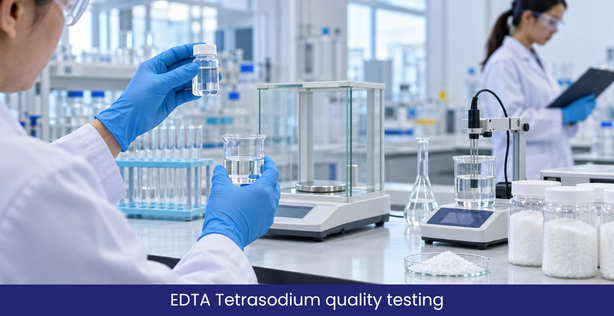
EDTA Tetrasodium is the fully neutralized sodium salt of ethylenediaminetetraacetic acid, used as a chelating agent that binds metal ions in water based systems. A product name alone does not show whether a proposed lot suits a buyer’s process, because grade, form and reporting conventions vary between offers. Approval should rest on a defined specification and on evaluation of representative material. Results are comparable only when produced under consistent conditions, so every value collected should state how, on what basis and under which conditions it was obtained.
Defining Tetrasodium EDTA Quality Requirements
Evaluation starts by fixing the reference against which material will be judged. Confirm the exact material being quoted, including its grade and physical form, and have the grade named in writing.
Obtain the specification that applies to that grade and keep it separate from internal requirements, which reflect the buyer’s formulation and may be narrower. Tetrasodium EDTA quality is then judged against both documents, not against general claims.
If an EDTA Tetrasodium supplier or chelating agent manufacturer cites a pharmacopoeial, food or other formal standard, request the edition and supporting evidence. EDTA salt quality standards are not universal; in most transactions the operative reference is an agreed specification. Also confirm which batch records exist and whether the sample represents the material to be supplied.
Parameter | Information needed before evaluation |
Active content or assay | Definition, reporting basis and applicable method |
Solubility | Meaning of the stated claim and evaluation conditions |
pH | Solution preparation and measurement conditions |
Batch consistency | Comparable results from identified batches |
Storage and handling | Instructions applicable to the supplied material |
EDTA Tetrasodium Purity and Assay
Purity, assay, active content and chelating capacity are not interchangeable. An assay is a measured content obtained by a stated method; purity is often a summary claim; chelating capacity expresses how much metal ion a given mass can bind.
Shivam Agro Industries lists a minimum active content of 99% and an active content expressed as EDTA of 69%. These are separately reported figures; buyers should confirm what each represents and how it is calculated. The method used and whether results are reported as received, after drying or on the anhydrous salt also need confirming.
Because the salt can exist in anhydrous or hydrated forms, water content changes the mass basis. When reviewing offers from any industrial EDTA supplier, align method and basis before comparing numbers.
A specification minimum is a limit, not a result; batch documentation should report the measured value. Further impurity checks, such as chloride, depend on the application. Personal care, food related or analytical uses may need tests a technical use does not, and their limits should be agreed with the supplier and laboratory.
Tetrasodium EDTA Solubility Characteristics
Supplier solubility statements are often qualitative. The buyer’s practical question is narrower: whether the supplied grade dissolves acceptably at the concentration and conditions of use.
Solubility is the maximum amount that dissolves at equilibrium, while dissolution rate is how quickly that happens. A highly soluble powder can still dissolve slowly if particles are coarse or caked. Ask whether any claim is descriptive or measured.
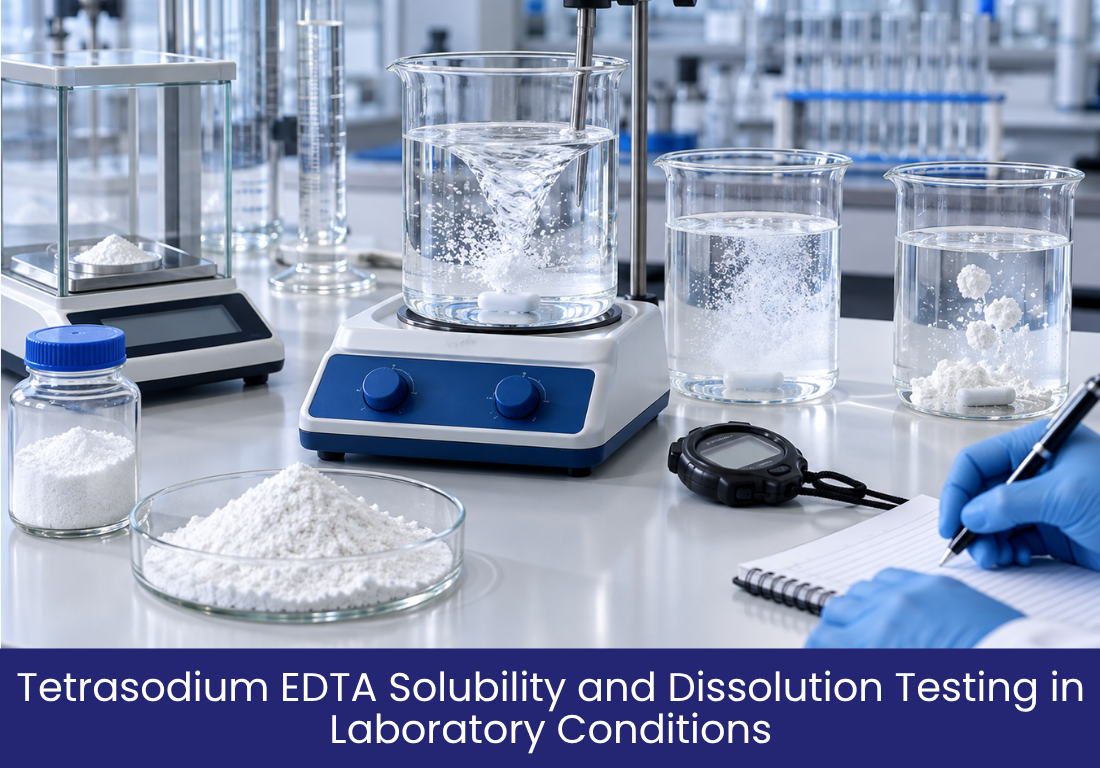
When observing dissolution of the supplied grade, document:
- Sample mass, water volume and water quality
- Temperature
- Mixing method and intensity
- Time to visual clarity and total observation time
- Any residue, cloudiness or sediment
A clear solution does not prove chemical purity, and haze or residue does not by itself prove a purity failure. Unexpected observations call for investigation. Behavior in the intended formulation must be evaluated separately.
EDTA Tetrasodium pH Measurement Conditions
Shivam Agro Industries lists a pH of 10.5–11.5 for a 1% solution. Buyers should confirm the concentration basis, test temperature and measurement procedure before comparing results. Reference data report a pH of 11.3 for a 1% solution (PubChem).
A reading taken at another concentration or temperature is not directly comparable with the stated range. Measurements should use a calibrated meter under the laboratory’s established procedure.
A result within range shows the expected alkalinity, but it does not confirm active content or exclude impurities. The pH of the test solution is also not the pH of the buyer’s product, which is controlled against the formulation’s own requirements.
Batch Consistency from an EDTA Tetrasodium Supplier
A specification sheet states what every lot should meet; it does not show how lots vary. Consistency is assessed from measured results for several identified batches, and one satisfactory sample cannot demonstrate it.
Compare only equivalent parameters reported on the same basis and method. The evaluation sample should be traceable to a batch reference, and proposed supply should match the grade and form evaluated.
- Tabulate agreed parameters by batch reference and date
- Note results close to a specification limit, not only those outside it
- Compare the sample’s results with the supplier’s data for the same batch
- Resolve discrepancies with the supplier before approval
- Keep recording incoming results to detect gradual variation
EDTA Tetrasodium Storage and Handling Checks
Condition checks are distinct from analytical testing. They establish whether material reaching the laboratory and plant is in a state that makes test results meaningful.
On receipt, verify that packs are intact and sealed and that labels carry the product name and a batch reference matching the documentation. Follow the safety data sheet for the specific material and the storage conditions the supplier specifies, and confirm pack format with the supplier.
- Open, sample and reseal packs under a defined internal procedure
- Record caking, discoloration, damaged liners or wet packaging, with photographs and batch references
- Hold material of uncertain condition until the supplier clarifies the cause
A visible change is a reason to investigate, not proof of contamination or degradation. An unchanged appearance does not confirm that material meets specification.
About Shivam Agro Industries
Shivam Agro Industries is a manufacturer and supplier based in Mehsana, Gujarat, India, producing chelating agents, amino acid chelates and related chemicals. Its listed range covers EDTA Acid and its sodium salts, EDTA Disodium and EDTA Tetrasodium; metal chelates comprising EDTA Calcium, EDTA Copper, EDTA Ferric, EDTA Magnesium, EDTA Manganese, EDTA Zinc and Fe EDDHA; glycine and glycinate compounds comprising Glycine, calcium, copper, ferrous, magnesium, manganese and zinc glycine amino acid chelates, and potassium, selenium, chromium and cobalt glycinates; and dried ferrous sulphate, zinc sulfate monohydrate, copper sulphate and magnesium sulphate anhydrous. Buyers can contact Shivam Agro Industries to confirm the specification and batch quality information available for their required EDTA Tetrasodium grade.
Conclusion
Approving EDTA Tetrasodium is a quality decision. Compare the proposed material with an agreed specification and internal requirements, using results reported on a stated basis, drawn from identified batches and supported by handling information for the supplied grade. Where any value, method or condition remains unclear, clarify it with Shivam Agro Industries before approval, so that the material accepted is the material that was evaluated.