


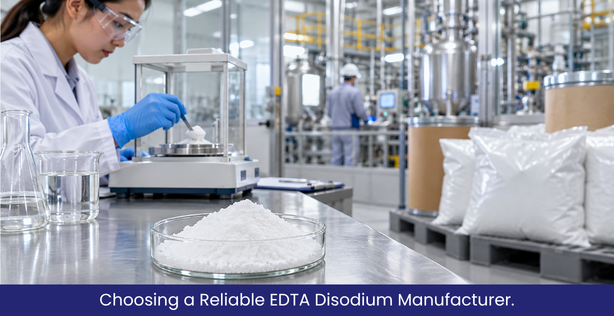
Choosing an EDTA Disodium source on price alone can leave a plant with material that is cheaper per kilogram but costlier per batch. Disodium EDTA is a chelating agent: it binds metal ions to help control their interference in a process, and its performance depends on the form, grade and consistency actually delivered. Before approving an EDTA Disodium supplier, buyers should confirm application fit, a clearly defined specification, accountable production and purchasing terms that suit regular operations.
Understanding Disodium EDTA Grades for Industrial Use
Chemical identity tells a buyer what the molecule is; grade tells them what the material has been made and tested to do. Two lots sold under the same name can differ in hydration state, impurity profile and the standard applied to them. A Disodium EDTA manufacturer should name the exact form and grade on the quotation itself.
Hydration state deserves particular attention. Disodium EDTA may be supplied as a hydrate, where water forms part of the crystal, or in anhydrous form, and the two deliver different amounts of EDTA per kilogram. Ask any EDTA chemical manufacturer under review which form is quoted and whether its stated molecular weight matches that form.
Shivam Agro Industries lists EDTA Disodium uses spanning water treatment, textiles, detergents, personal care, pharmaceuticals, chemical processing and laboratory work. These sectors differ in impurity tolerance and documentation needs, so a listed application shows market relevance rather than suitability for your process.
A purity figure alone therefore cannot approve a grade. Whether an EDTA salt manufacturer can supply the right material also depends on trace contaminants, solubility at your operating temperature and the documents your market expects. If grades are not clearly identified, request them in writing with the standard each one meets.
Key Factors When Selecting a Disodium EDTA Manufacturer
Before investing technical review time, confirm that the business can act as a bulk Disodium EDTA supplier for your expected volumes and order pattern. Detailed quantity, packaging and delivery terms come later in the commercial review.
Next, establish who actually makes the material. Some sellers produce every grade they offer, while others produce part of the range and source the rest. Either model can work, but the buyer must know which applies to the quoted item. Confirm:
- The legal entity and plant address responsible for production
- The exact product name, form and grade covered by the quotation
- A named contact for technical and quality questions
- How batch numbers appear on packs and documents, and how they link to production records
- The agreed procedure, timeline and remedy if delivered material is disputed or rejected
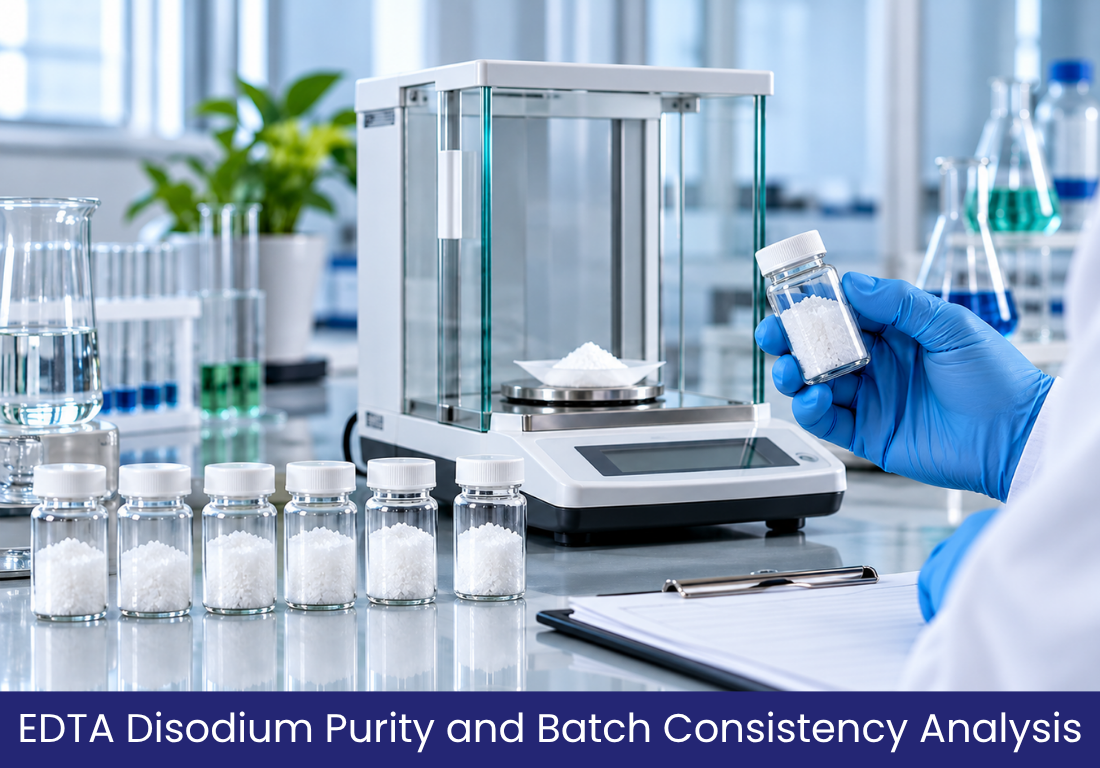
Evaluating EDTA Disodium Purity and Batch Consistency
The following checks help buyers evaluate Disodium EDTA. Confirm which parameters the supplier specifies and request additional testing where your application requires it.
Parameter | Buyer evaluation point |
Minimum active content | Reporting basis and hydration form stated |
Molecular weight | Matches the form named on the quotation |
Solution pH | Test concentration and temperature stated |
Chelation value | Unit, reference metal and method stated |
Solubility | Temperature and concentration of the test stated |
Heavy metals and insoluble matter | Limits requested where your market or filtration step needs them |
Appearance | Screening check only, not proof of purity or compatibility |
Assay figures can only be compared once their basis is known. Confirm whether active content is reported on an as received or dry basis, whether it is calculated as the hydrate or the anhydrous salt, and which test method produced it, since the same material can show different figures on different bases. Purity, assay and active content are not interchangeable unless the specification defines them that way, so convert competing offers to one common basis before comparing price per unit of active content.
Solution pH is meaningful only with its test conditions. A stated range applies to the concentration and temperature at which it was measured. Compare it with the pH of your own system, because the pH at which disodium EDTA operates affects how strongly it holds particular metal ions.
Chelation value describes binding capacity, but suppliers may express it in different units, for example milligrams of calcium carbonate per gram. Confirm the unit, reference metal and method before comparing offers, since figures on different bases cannot be ranked directly.
Specification limits describe what the supplier promises; batch results show what was produced. Request results from several recent batches and check where they sit within the limits, not merely whether they pass. Results consistently close to a limit leave less acceptance margin, while shifts across batches may indicate variation that needs investigation.
Trials should reproduce actual formulation conditions. Confirm the sample comes from regular production of the quoted grade, then test it at your working concentration, temperature and water hardness, alongside the metals, surfactants or other ingredients it will meet.
Record dissolution time and order of addition during trials, since a grade that performs in pure water can behave differently in a full formulation. Before the first order, write down your incoming acceptance criteria and share them with the supplier.
Quality Assurance During EDTA Disodium Production
With any producer, ask how each production stage is controlled for the quoted grade.
- How incoming raw materials are tested or verified before use
- Which checks run during production, and what happens when a result falls outside limits
- Which tests are completed before batch release, and whether they cover the full agreed specification
- Which batch quality records can be shared, and how long they are retained
- Who holds authority to release a batch, and whether that role is independent of production
- How nonconforming batches are investigated and whether customers are informed
- Whether buyers receive advance notice of changes to raw materials, process, plant or specification
File written answers and sample records with the supplier approval. Where your market requires certification or registration, request current certificates covering the grade and plant, since purity data does not replace them.
Assessing Bulk Disodium EDTA Supply Arrangements
Once material and producer are approved, commercial terms decide whether supply runs smoothly. Confirm each area in writing, referencing the approved specification by grade and version.
Supply area | Detail to confirm |
Quantity | Annual and per order volumes, any minimum order requirement, and capacity for growth |
Packaging and labeling | Pack type, net weight, liner, palletization, and labels showing grade and batch number |
Repeat orders | Order frequency, scheduled call offs and how volume is reserved |
Pricing | Quotation validity, basis for price revisions and notice period |
Lead time | Quoted dispatch time from order confirmation and how delivery dates are confirmed |
Shipment terms | Incoterm, freight, insurance and the point where risk transfers |
Handling | Supplier storage and handling instructions and safety data sheet |
Documents | Invoice, packing list, certificate of analysis, and any origin or export documents your destination requires |
Compare offers on total delivered cost, including freight, insurance, duties, packaging and safety stock, rather than ex works price.
Ask how deliveries would continue during a raw material shortage or plant shutdown. Treat any statement of availability as something to verify against your forecast, not as a guarantee.
About Shivam Agro Industries, EDTA Chemical Manufacturer
Shivam Agro Industries is a manufacturer of EDTA chemicals and chelated micronutrients at Ranasan GIDC, Mehsana district, Gujarat, India. Its range covers EDTA Acid, EDTA Disodium and EDTA Tetrasodium; zinc, copper, manganese, magnesium, calcium and ferric EDTA chelates, plus Fe EDDHA; Glycine, the bisglycinates of zinc, magnesium, manganese, copper, calcium and iron, and potassium, selenium, chromium and cobalt glycinate; and Dried Ferrous Sulphate, Zinc Sulfate Monohydrate, Copper Sulphate and Magnesium Sulphate Anhydrous. Buyers can contact Shivam Agro Industries to confirm the available form, specification and supply terms for their Disodium EDTA requirement.
Conclusion: Approving Your EDTA Disodium Supplier
Approve EDTA Disodium only when the material has passed your own formulation trials and the supplier has shown production evidence and commercial terms that meet your purchasing requirements. To start an evaluation, send Shivam Agro Industries your intended application, required specification, expected quantity and delivery location through its enquiry form.